
Woodwind Gourmet: Jacques’ Pain Perdu

My fascination with composers’ eating habits began innocently enough in my undergraduate years… now that I’m no longer a student and can study anything I choose, I’ve decided to dust off that quest and go off in search of my favorite composers’ favorite breakfasts!
It’s interesting to note the stories of composers whose parents approved of their vocation and compare them with composers whose musical pursuits went against their parents’ wishes. Jacques Ibert (1890-1962) was in the unique position of being supported endlessly by his mother while being completely disapproved of by his father.
Some say it’s a subtle theme underscoring much of his work: an underlying sense of never quite belonging. Looking over Ibert’s catalog of works, you notice he wrote for many different kinds of ensembles and for vastly different purposes. In fact, he’s most noted for being an eclectic — never aligning himself with prevalent genres or styles yet borrowing and combining all of their elements.
Ibert’s mother — an accomplished pianist — was his first music teacher. His father, a businessman, withdrew all financial support when — at age 21 — Jacques resigned from  his position at his father’s company to enter the Paris Conservatoire. To provide for himself, Ibert eked out a living by working as an accompanist and writing pop songs under a pen name. Proving his prowess as an improviser, he was also employed as pianist at a silent film theater where he performed music to fit the action taking place onscreen. He went on to write over 60 film scores.
Spanning many genres and media, Ibert also composed operas, ballets, concertos, and varied forms of incidental and chamber music. Manitou Winds studies his Cinq Pièces en Trio (1935) for oboe, clarinet, and bassoon. We’re soon to delve into his Trois Pièces en Brèves (1930) for wind quintet.
Though he rose from obscurity to prominence during his lifetime (winning numerous awards), it is perhaps because of his refusal to pursue a single musical genre or form that he’s not on many “Top 10” lists of composers. Instead, audiences are often pleasantly introduced to him when one of his works graces a program. Hopefully his daring use of orchestral colors peppered with hidden musical surprises will continue to inspire musicians and audiences alike to seek out more of his music.
A composer growing up in Paris while bridging the 19th and 20th centuries probably ate some interesting breakfasts — a mix of gourmet and eating on the cheap. In homage to Ibert’s eclecticism, I thought it would be appropriate to highlight a recipe that is simultaneously simple while betraying decidedly gourmet influence. Today’s recipe is an autumn-inspired riff on classic Pain Perdu (literally “lost bread”). Dressed down, it’s just stale bread dipped in egg batter and fried up. Dressed up, it’s adorned with exotic spices and rich, complex flavors of fruit and wine.
___________________________________________________________
Pain Perdu with Fruit Compote
Serves 2
Fruit Compote:
2 cups Riesling or Gewurztraminer
2 cups water
1/3 cup granulated sugar
1 3-inch Ceylon cinnamon stick
 1 star anise
2 whole cloves
8 mission figs, stems removed, quartered lengthwise
10 dried apricots, cut into strips
3/4 cup dried tart cherries
Pain Perdu:
2 large eggs
1/4 cup milk or heavy cream
1 tablespoon maple syrup
1/4 teaspoon vanilla extract
1/8 teaspoon sea salt
1/8 teaspoon ground cinnamon
1 tablespoon unsalted butter
4 slices bread (brioche or challah are ideal)
Lightly Sweetened Whipped Cream
To make the Fruit Compote: In a medium saucepan combine wine, water, and sugar. Combine the cinnamon stick, anise, and cloves in a teabag or piece of cheesecloth; tie closed with kitchen string. Add spice bag to saucepan; cook and stir over medium-high heat until mixture comes to boiling. Add figs and cook for 3 minutes. Add apricots and cook for 3 minutes more. Add cherries and cook for 2 more minutes.
Using a slotted spoon, transfer fruit to a bowl. Raise the heat slightly and continue cooking liquid for 15-20 minutes or until reduced to about 1 cup. Remove spice bag and discard. Pour liquid over fruit. Allow to come to room temperature, then chill, covered, up to 4 days. (Leftover compote makes an excellent accompaniment for plain yogurt, oatmeal, or poundcake!)
To make Pain Perdu: In a shallow dish, whisk together the eggs, milk, maple syrup, vanilla, salt, and cinnamon. Melt half of the butter in a large non-stick skillet over medium-high heat. While the skillet is heating, dip the bread slices into the batter, turning them and re-dipping as necessary until the batter has been absorbed. Place  two slices of bread in the skillet; cook approximately 2 minutes on each side or until browned. Remove from skillet (slices can be kept warm in a low oven if desired); add remaining butter and brown remaining slices.
To serve: Warm the finished compote slightly. Divide bread slices between two plates. Top each with several scoops of the macerated fruit from the compote then drizzle each serving with several spoonfuls of the spiced syrup. Garnish each serving with a dollop of whipped cream and a dash of ground cinnamon.
___________________________________________________________
For the perfect Ibert soundtrack to your whisking, dipping, and noshing, here’s one of Ibert’s best-known works: Divertissement (1929).
[youtube https://www.youtube.com/watch?v=CeKTKKt1nJo&w=420&h=315%5D
Looking for more recipes? Check out the other recent Woodwind Gourmet series:
Woodwind Gourmet: Haydn’s Cherry-Almond Tart

My fascination with composers’ eating habits began innocently enough in my undergraduate years… now that I’m no longer a student and can study anything I choose, I’ve decided to dust off that quest and go off in search of my favorite composers’ favorite breakfasts!
When we think of the lives of Classical music’s most storied composers, what likely comes to our minds is either stuffy, powdered wig scenery (fancy galas with wealthy people dressed in their finery) or we think of the tortured, starving artist scribbling onto scraps of manuscript paper. While both images are in some cases true, each composer’s story is unique in its own way — even when compared to composers of the same time period.
Joseph Haydn (1732-1809) is one of my favorite composers — and not just because of his music. Haydn’s story is one of those classic, rags-to-riches narratives with a happy ending. Born in a small town to parents who could neither read music nor provide him with any advanced training, Haydn slowly and patiently worked his way  through the often complicated layers of 18th century society to become one of the greatest and most prolific composers in history.
Haydn went from a nearly-starved schoolboy to a wealthy and well-connected composer who enjoyed celebrity status in his later years. While he’s regarded as the “father” of both the symphony and the string quartet, it’s amazing to realize he was neither a child prodigy nor privileged enough to receive formal instruction in composition. Thus, he was largely self-taught — privately working his way through textbooks and scores while working odd jobs as a young man.
Because of his skills as a violinist, he gradually gained the favor of aristocratic patronage. When he eventually came to be an official staff member of Hungarian nobility, he was finally in a position that would provide him with all the resources needed to hone his compositional skills. In fact, his success in composition became a vital part of staying alive!
Like any other member of staff, he wore a uniform and lived in servants’ quarters. Rather than scrubbing chamber pots and clearing out horse stables, however, he was required to write, rehearse, and conduct all of the music for the noble family and their many guests. During his time with the Esterházy family (1761-1790), he faced a mountainous workload and ever-shifting musical and non-musical demands. Thankfully, he also had daily access to his own very talented orchestra and the finest singers. This proved to be most advantageous for his artistic growth, allowing him to experiment at  will. Within the staggering musical output he created while serving the Esterházy family, one can trace the evolution of style and technique that eventually shaped all of Classical music — and he was self-taught!
The immense wealth of the Esterházy family eventually led them to construct a new palace (mainly as a summer residence) in Esterháza. It was an immense palace not only boasting 126 rooms but also containing its own church, opera house, and marionette theater. Haydn’s residence was moved each year from Eisenstadt to the Esterháza estate each time the family relocated. Though trapped in the middle of nowhere — isolated from civilization and in the middle of what was then swampland — work never slowed for Haydn.
On one occasion, after having returned once again to Esterháza, Haydn wrote in a letter to his friend Marianne von Genzinger:
Well, here I sit in my wilderness; forsaken, like some poor orphan, almost without human society, melancholy and dwelling on the memory of past glorious days… I lost twenty pounds in weight in three days, for the effects of the good fare at Vienna has disappeared on the journey back. Alas! alas! thought I to myself, when forced to eat…a tough grill instead of a Bohemian pheasant, Hungarian salad instead of good juicy oranges, and dry apple fritters instead of pastry. Here in Esterháza no one asks me, “Would you like chocolate with or without milk? Will you take coffee with or without cream? What can I offer you, my good Haydn? Will you have vanilla ice or strawberry?”
Being a man who obviously appreciated good food, Haydn would have loved today’s recipe — a slice of this Viennese-style Cherry-Almond Tart served alongside his morning coffee (with or without cream, whichever he wished).
___________________________________________________________
Cherry-Almond Tart
Serves 8-12
Tart Shell:
1 large egg
1 large egg yolk
1/3 cup granulated sugar
 1/4 teaspoon sea salt
8 tablespoons unsalted butter, room temperature
1 1/3 cups whole wheat pastry flour
2/3 cup cake flour
Filling:
1 cup coarsely chopped almonds
1 1/2 tablespoons all-purpose flour
2/3 cup granulated sugar
9 tablespoons unsalted butter, room temperature
1 large egg
1 large egg white
1/2 teaspoon almond extract
2 cups pitted tart cherries – (fresh, canned, or thawed frozen)
For the shell: Whisk together the egg, egg yolks, sugar, and salt in a large bowl; whisk until mixture turns a light yellow. Continuing to whisk, add softened butter one tablespoon at a time, whisking until combined. With a wooden spoon, gradually work in both flours until a smooth dough forms.
Place a large sheet of plastic wrap on work surface. Empty dough onto the plastic wrap; knead gently to incorporate any loose dry ingredients. Form dough into a disk and cover with plastic wrap; chill for at least 2 hours and up to 24 hours.
For the filling: Add almonds and flour to the bowl of a food processor; pulse until larger pieces are more manageable and then finely grind. Add the sugar; pulse briefly. Next, add softened butter and extract; blend until smooth. Mix in egg and egg white. Transfer filling to medium bowl; cover and chill until needed.
To assemble and bake: Remove tart dough disk from refrigerator and allow to stand at room temperature for about 5-10 minutes to soften slightly. Place the dough in a removable-bottom tart pan (you may use a 9-, 10-, or 11-inch tart pan); pressing the dough, work it with your fingertips to cover the bottom and sides of the pan. Using a fork, prick the bottom of the shell in several places. Place unbaked shell in freezer to chill for 20 minutes. Meanwhile, preheat oven to 400-degrees. Place rack in center of oven.
Remove shell from the freezer; cover with two overlapping sheets of aluminum foil. Fill tart pan with pie weights making sure the weights are to the top of the pan and evenly distributed over the entire surface. Bake the shell for 20 to 25 minutes or until it is  dry and lightly golden brown. Gently remove foil and weights; allow to cool on wire rack before filling.
Reduce oven temperature to 350 degrees F. Once shell has cooled, spread the chilled filling evenly into the bottom. Place cherries atop filling and bake for 40-50 minutes or until filling has puffed and browned slightly. Allow to cool completely before serving.
___________________________________________________________
Want an ideal Haydn-esque soundtrack to enjoy your coffee and tart? Haydn’s Symphony No. 45 in F-sharp Minor (The “Farewell” Symphony) is entirely appropriate. The final movement was Haydn’s nudge to Prince Esterházy that it was time to pick things up, leave the swamp, and head back to Eisenstadt. During the adagio in the fourth movement, each musician stops playing, snuffs out the candle on his music stand, and leaves in turn, so that by the end, there are just two muted violins left on stage!
[youtube https://www.youtube.com/watch?v=KXctarOxRz8&w=420&h=315%5D
Looking for more recipes? Check out the other recent Woodwind Gourmet series:
Woodwind Gourmet: Bach’s Bread & Biersuppe

My fascination with composers’ eating habits began innocently enough in my undergraduate years. Between long stints in the practice room, I would sit in the music building break room where I would invariably find myself in the company of many of my classmates. We were always in various stages of pain or ecstasy with our homework or practicing.
During one particularly long spell of analyzing the harmony and form of a Bach prelude, one of my classmates became frustrated and sighed, “I don’t care what Bach ate for breakfast, I just need to get through this assignment!” We all chuckled because we understood the sentiment; getting bogged down in the minute details of a piece was often exhausting while it was pure bliss to simply get lost in the beauty of its sound.
Later, I found myself casually wondering, “What did Bach eat for breakfast?” I carefully filed that curiosity away for a more appropriate time, since there were more pressing matters at hand. But, now that I’m no longer a student and can study anything I choose, I’ve decided to dust off that quest and go off in search of my favorite composers’ favorite breakfasts!
Which, of course, eventually leads us to Germany in the early 1700s and may involve some “dramatic interpretation” on your narrator’s part…
Johann Sebastian Bach, who had just entered his twenties, had recently been appointed organist at St. Boniface’s Church in Arnstadt. Disenchanted with the choir and his  responsibilities, he applied for a one month leave of absence to visit and study with the great organist/composer, Dieterich Buxtehude in Lübeck.
While it’s fascinating that Bach was so intrigued by Buxtehude that he abandoned work and steady pay to study with him, it’s even more daunting to realize Bach made the journey from Arnstadt to Lübeck (more than 260 miles) on foot… in the winter of 1705. Now that’s what you call suffering for your art!
So enamored was Bach of Buxtehude’s music and technique, he over-stayed his leave by a few months and did not return until February of 1706. Remarkably, he also made the return journey on foot, but this time he was carrying on his back several handwritten manuscript copies he’d made of Buxtehude’s works!
Travel by foot was very common in those days unless you were very wealthy, so it’s likely Johann wouldn’t have stood out from any of the other wanderers looking for food and shelter. So, historians know very little about this entire, life-changing episode in Bach’s life. Perhaps that’s why it has always fascinated me. How many days did his journey take? What route did he use? Where did he sleep? More importantly, what did he eat?!
I like to imagine the young, carefree Johann stopping off in some wayside town. Maybe a charming little village where he was offered lodging for the evening and a simple breakfast by some adorable, matronly hausfrau. And what might this hausfrau have served him for breakfast? According to some food historians, it may have been Brot und Biersuppe (Bread and Beer Soup).
Here follows the Woodwind Gourmet’s take on this very old breakfast specialty that’s been in existence since medieval times. Baking the oaty, mellow homemade bread will make it a cozier meal, but feel free to substitute any hearty bread you might already have on-hand. For the beer, I used a Guinness Extra Stout, but any dark beer or stout that you prefer would work for the soup.
___________________________________________________________
Bach’s Bread & Biersuppe
Bach’s Bread
Yields 1 loaf
2 1/4 teaspoons active dry yeast
 1 1/4 cups warm milk (100-110-degrees)
1 1/2 cups unbleached bread flour
1 1/2 cups whole wheat flour
1 cup old-fashioned rolled oats
2 tablespoons unsalted butter, softened
1 1/2 teaspoons sea salt
3 tablespoons honey
In a small bowl, dissolve the yeast in the warmed milk. Set aside.
In a large mixing bowl, or in the bowl of a stand mixer, combine the remaining ingredients. Pour in the yeast mixture; stir to form a shaggy dough. Knead dough, by hand (10 minutes) or by machine (5-8 minutes) until smooth and elastic. Place dough in a lightly greased bowl, cover and allow it to rest for 1 hour until doubled in size. Gently deflate the dough and transfer to a lightly oiled surface.
With your hands, press the dough into a rectangle and then tightly roll into a log, pinching the seams to seal. Place in a lightly greased 9″ x 5″ loaf pan, cover the pan loosely and allow dough to rise for 60 to 90 minutes, just until it’s crested 1″ to 2″ over the rim of the pan.
Bake in a preheated 350-degree oven for 35 to 40 minutes, until an instant-read thermometer inserted into the center registers 190°F. Allow to cool before slicing. This loaf can be made in advance and freezes well.
Biersuppe
Serves 2
1 1/2 tablespoons unsalted butter
2 tablespoons minced shallot
1 clove garlic, minced
 1/2 teaspoon dried thyme
1/2 teaspoon dried tarragon
1/2 teaspoon dried sage
1 cup dark beer or stout
1 cup chicken or beef stock
1 tablespoon brown sugar
2 egg yolks
1 tablespoon all-purpose flour
1/4 teaspoon ground mace
1/4 teaspoon freshly ground pepper
1/2 teaspoon sea salt (or to taste)
In a 2-quart saucepan, melt the butter over medium-low heat. Sauté the shallots and garlic until softened; add the thyme, tarragon, and sage, stir for 30 seconds. Add the beer, stock, and brown sugar; cook, stirring occasionally, until mixture comes to a low boil.
Meanwhile, in a medium bowl, whisk together the egg yolks and flour. While whisking, slowly pour in about half of the hot beer mixture. Pour the contents of the bowl back into the saucepan and continue cooking until mixture returns to boil and thickens sufficiently. Stir in the mace, pepper, and salt.
To serve, toast slices of bread and generously butter. Place the toast in shallow bowls and ladle soup around toast.
___________________________________________________________
To accompany your stirring, kneading, whisking, and slurping, here is a signficant collection of Bach’s organ music (The Orgelbüchlein) — most of which was likely composed after his visit with Buxtehude.
[youtube https://www.youtube.com/watch?v=i4psd76iTfc&w=560&h=315%5D
Looking for more recipes? Check out the other recent Woodwind Gourmet series:
August Was a Busy Month
August was certainly a busy month for the musicians of Manitou Winds. Still reeling from the preparation and performances for the 2015 Traverse City Film Festival, we put in a lot of rehearsal time for another promotional concert for the Benzie Area Symphony Orchestra at Stormcloud Brewing Company, in Frankfort.


This second performance at Stormcloud featured the Manitou Winds NEO Trio in a full hour of music. We enjoyed being a mellow backdrop for the brewery’s patrons on a beautiful summer afternoon.
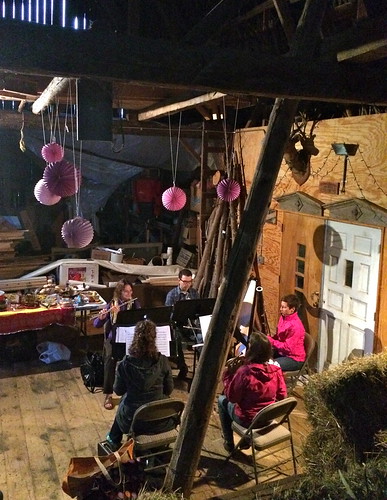
July and August were full of performances and appearances for Manitou Winds, so we wanted to take some time out for rest and celebration amidst all these dates scribbled on our calendars. What better time for a potluck?! We gathered close friends and family and met in Laura’s barn for a potluck dinner and a mini concert. It was a fun evening in spite of the unseasonably chilly weather!


While putting together the program for Stormcloud, the NEO Trio was also arranging and rehearsing for hymns and special music for the August 30th Sunday morning worship service at Grace Episcopal Church in Traverse City. While we truly enjoy sharing our music with everyone, we relished our first opportunity to perform music in a quieter, reverent setting (i.e., not in a crowded movie theater or a lively brewery).
Here is a short video taken during our rehearsal with Grace Episcopal’s organist, Kathy Will:
[youtube https://www.youtube.com/watch?v=XeNs6SIdRQE&w=560&h=315%5D
And now, as the tourists are beginning to pack up their belongings and the leaves are conspiring to change at any minute, we are beginning rehearsals for our December concert: Winter Songs & Carols on Saturday, December 5th, at 7:30pm. See our Performances Page for more information about upcoming concerts and events.
2015 Traverse City Film Festival
 In July, Manitou Winds was selected from among a large pool of talented musicians to participate in the 2015 Traverse City Film Festival! Musicians from across Northern Michigan — and all across the country — were invited to submit videos and samples for consideration by the festival committee. It was truly an honor to be selected!
Our first performance was at Traverse City’s Clinch Park at The Open Space. As it happened, this was the premiere of our NEO Trio — Sam Clark, Anne Bara, and Jason McKinney. On one of the windiest days in memory, the trio took the stage armed with weighted stands and all manner of safeguards to protect them from the elements — even the film festival crew had to wait to assemble the large outdoor screen due to the windy conditions!


Sheet music was airborne several times, Sam’s embouchure and breath support were tested every other measure by the gusts, Anne’s music stand had to be anchored with ballast, and Jason’s harp strings were alive with vibration from the wind — like a Celtic war harp! It was an epic premiere to say the least.

But, as the crowd assembled and the sun slowly approached the horizon, the trio played nearly an hour of relaxing music which was carried by the gale-force winds to folks near and far. We couldn’t have asked for a more beautiful venue.


Next, the trio high-tailed it to the State Theatre for their next performance just 20 minutes later! They were honored to play 30 minutes of repertoire for a full house of movie patrons! It was an unforgettable evening of music which would have been an impossible feat if not for the many film festival volunteers who assisted the trio in getting on and off the stage and swiftly to the next venue. The trio also owes a big thanks to Bill Fromm and James Deaton (our unofficial roadies) who helped load and unload equipment — including Jason’s heavy, not-nearly-as-portable-as-it-looks keyboard.
On July 31st, the Manitou Winds quintet performed for another full house at the Old Town Playhouse. Trios, quartets, quintets — we pulled repertoire from several sources for the performance.


The Traverse City Film Festival is a volunteer-based festival that accomplishes miraculous feats of logistics and organization each year as festival attendance continues to grow along with the number of film venues. We were proud to be a part of the festival, this year, and hope to have the opportunity again.
__________________________________________________________
Want to see some video clips of our 2015 TCFF Performances? Visit our Facebook Page for videos, photos, and more!
Thank You, Stormcloud!
The members Manitou Winds had their premier performance at Frankfort’s Stormcloud Brewing Company on Saturday, July 11th. Performing on the beautiful patio at the brewery, the ensemble had a very receptive audience who were also enjoying the brewery’s tasty offerings.
If you weren’t able to join us for our debut, check out our video montage of the event which has snippets of several pieces:
[youtube https://www.youtube.com/watch?v=SvXWheTpYhc&w=560&h=315%5D
Thanks, again, to Rick Schmitt of Stormcloud Brewing Company for inviting us to perform. And, remember, we’ll be back at Stormcloud on August 22nd, at 4:00pm, with the Manitou Winds NEO Trio.
Manitou Winds at Stormcloud Brewing Company
 Manitou Winds’ July 11th performance at Stormcloud Brewing Company is part of a special series to promote the Benzie Area Symphony Orchestra’s concerts for the 2015 season. Jason McKinney and Laura Hood perform regularly with the symphony and invite you to attend the upcoming BASO concert on Sunday, July 12th, 7:00pm at the Benzie Central High School Auditorium.
Special thanks to our gracious host, Rick Schmitt of Stormcloud Brewing Company, for inviting us and supporting both community and the arts in Benzie County and Northwest Michigan.
We hope you enjoy the concert! Click HERE for a program to follow along with the performance. Below are some program notes to give you behind-the-music knowledge about the composers and their pieces.
PROGRAM NOTES
Passacaille — Adrien Barthe (1828-1898)
A very self-critical and arguably unnoticed composer in his day, Adrien Barthe devoted much of his time to teaching rather than seeking to be published and performed. Consequently, many of his works were published posthumously.
A passacaille was originally a 17th century Spanish term for an instrumental interlude between dances or songs. In spite of the term’s Spanish origins, the earliest existing examples of the musical form are from 17th century Italian sources. It was the Italian composers who defined the form as a series of variations over a continuous bass line. As Barthe was a French composer from the 19th century, it’s interesting to note the juxtaposition of nationalistic and historical influences in this single-movement piece.
Cinq Pièces en Trio — Jacques Ibert (1890-1962)
Published in 1935, Cinq Pièces en Trio splendidly demonstrates the extensive  imagination of a composer who made a career of refusing to attach himself to any musical descriptors or genres. He composed music for a vast litany of instrumentations and combinations — even venturing into the realm of film music. Like many eclectics, he faced hardships brought on by critics who tried to fence him in. In fact, for many years, his music was banned in his native France. Still, he went on to see many of his best works performed and lauded during his lifetime. His music is often described as festive, lyrical, evocative, and gently humorous.
Divertimento No. 11 in Eb Major, K. 251 — W.A. Mozart (1756-1791)
Mozart’s Divertimento No. 11, K. 251 was originally composed in July 1776. It’s believed Mozart composed it for the occasion of his sister’s name day (similar to our modern day birthday traditions).
Anna Maria “Nannerl” was four-and-a-half years his senior, and — though they traveled and performed together extensively as children — their paths diverged later in life so that they communicated in a dwindling stream of letters throughout their lives rarely seeing one another.
Still, history reminds us the bonds of siblings are unbreakable as Mozart wrote to his sister in June 1770, “Write to me and don’t be so lazy. Otherwise I shall have to give you a thrashing. What fun! I’ll break your head.” The first movement of the Divertimento, in particular, would make an excellent soundtrack for such a sound thrashing!
Divertimento in G Major, Hob. IV:3 — Joseph Haydn (1732-1809)
Haydn composed this divertimento in 1794 during a rather adventurous period in his life. Born in Rohrau, Austria, he’d spent 58 years of his life never traveling outside a 50km radius of his birthplace. It wasn’t until he was retired from his long-standing engagement  with Hungarian royalty in 1790, that he finally left his familiar radius, embarking on two separate voyages to London — it was the first time he’d ever seen the ocean!
Since he’d spent most of his life isolated from other composers and cultural influences, it must have been a gratifying experience to arrive in London and realize he was the modern-day equivalent of a celebrity.
I like to think that it was on one of those evenings at his magnificently appointed suite in London, surrounded by the noisy chatter of rapid-fire English, while gazing out over the busy city with fanciful ideas and ambitions swimming in his mind, that Haydn penned this divertimento.
Grow Old with Me — John Lennon (1940-1980)
Written in November of 1980 as a demo and not released until four years after his death, Grow Old with Me is surely one of the last songs ever written by John Lennon. Its lyrics were directly inspired by the poetry of both Robert and Elizabeth Browning:
Grow old along with me
The best is yet to be
When our time has come
We will be as one
God bless our love
God bless our love
 Grow old along with me
Two branches of one tree
Face the setting sun
When the day is done
God bless our love
God bless our love
Spending our lives together
Man and wife together
World without end
World without end
Grow old along with me
Whatever fate decrees
We will see it through
For our love is true
God bless our love
God bless our love
Inspired by Mary Chapin Carpenter’s recording of Lennon’s song, Jason penned an arrangement for soprano saxophone and string quartet in 2010 for his wedding ceremony. In 2014, he revisited the piece and — with the help of the members of Manitou Winds — created the arrangement you’ll hear today.
Divertimento No. 1 in Bb Major, Hob. II: 46 — Joseph Haydn (1732-1809)
This four-movement divertimento has long been attributed to Joseph Haydn, but a growing body of scholarship suggests the work was actually penned by one of his students (Ignaz Pleyel [1757-1831]). Though he was a student of Haydn’s, Pleyel’s music shared nearly equal popularity in the late eighteenth century. Centuries later, Haydn’s prolific catalog dwarfs that of his student’s, and the divertimento still appears on concert programs with his name next to it.
Travel Notes 2 — Richard Rodney Bennett (1936-2012)
Richard Rodney Bennett was a composer and performer of strikingly contrasting styles and genres — capable of wowing audiences in both concert halls and jazz clubs. Critics often  described him as “elusive” in that his consummate skills enabled him to channel any composer or style he wished, leaving you to wonder who the “real” Bennett was. His relatively vast catalog of compositions offers no clues as it reveals only a very gifted musician and composer who simply loved music. He communicated through the medium in whatever setting or style suited him at the time.
Travel Notes 2 was composed in 1976 — an indirect sequel to a string quartet of the same name written the previous year. Each of the movements very colorfully depict what might be scenes lifted from the pages of a very adventurous traveler’s diary.
Royal Garden Blues — Clarence & Spencer Williams (1893-1965, 1889-1965)
Royal Garden Blues was first published in 1919 and became an instant sensation (well, as “instant” as possible in the days before YouTube, iPhones, and Facebook).
Perhaps what caught most listeners’ attention was the fact that it was one of the first popular songs based on a “riff”. What’s a riff? In the simplest of definitions, it’s a small phrase that comes back again and again while various changes occur around it. As the riff is passed around the group, the soloists add their own herbs and spices to the basic recipe.
Quintette en Ut — Claude Arrieu (1903-1990)
Claude Arrieu (pseudonym of Louise Marie Simon) originally published this  five-movement wind quintet in 1954. Each of the movements showcases the brilliant wit and style of a composer who is sadly unknown to many concertgoers. Though she was quite the mover and shaker in her day — rubbing shoulders (albeit only stylistically) with the likes of Francis Poulenc and the other members of Les Six — it is primarily her vocal works that are still performed.
Clarinet Polka “Dzaidunio” — traditional
Like many tunes classified as “traditional,” Clarinet Polka‘s origins are fairly dubious. Some claim the music was written by an Austrian composer named A. Hupfata while others insist it was written under the name Dziadunio Polka by the Polish composer Karol Namysłowski. Regardless, the tune has been popular since the end of the 19th century and used in countless radio programs and recordings.
New Age Music: Part I
It’s tempting to think of history — especially music history — as a very measured and predictable timeline. In our hindsight, we imagine each event leading directly to the next. In this myopic view, styles and influences are neatly trimmed and defined without much overlap or gray area. Perhaps this is why we often find the present so very complicated: it doesn’t conform to our two-dimensional view of history.
In reality, most composers lived and died without knowing they were a part of what would later be considered a “movement” or a “style period”. For instance, Beethoven did not have business  cards imprinted with “Father of the Romantic Period, Master of the Symphony” in gold lettering at the bottom. Instead, composers studied and trained to create original music that was either in agreement with or a dramatic departure from the music they heard around them. As time progressed, trends emerged and we are able to apply those neat and tidy labels to composers and their music.
Similarly, New Age music — with its vast litany of influences and divergent sub-genres — is not easily defined or directly traceable to any one historical event or composer. Since historians typically mark its beginning in the 1970s, one could argue that it’s too new to be etched in stone. Geographically speaking, it began in the United States, but it bears undeniable influences from far beyond those borders. Rather than pinpointing a single musical or stylistic departure that developed into a very singular genre, it’s more accurate to say that New Age began as a rebellious, artistic reaction to both popular and art music of the mid twentieth century.
THE REBELLION BEGINS
Popular Music
By the mid 1970s, most popular music in the United States either danced to the very steady and funky rhythms of disco, or marched to the ripping, pounding, and droning of rock and punk rock.1 [Listening Samples: The Rolling Stones’ It’s Only Rock ‘n Roll (1975); K.C. & The Sunshine Band’s That’s the Way I Like It (1975); The Ramones’ Blitzkrieg Bop (1976)]
New Age music can been seen as a departure from the pop music of the time, because it sought to strip away the angst, materialistic drive, and the loud, urban-based, fast-paced consumerism of music. Its earliest roots were in music from a spiritual movement known as New Age. This was music intended for focus, meditation, healing, and a deeper sense of spirituality. [Listening Samples: Steven Halpern’s Chakra Suite (1975); and Kitaro’s Full Moon Story (1979)]
“New Age music started as a meditative sound, often of unresolved melodies, bright, sparkling timbres, and more reverb than the Grand Canyon… but “New Age” became an umbrella marketing term in the 1980s for anything instrumental that veered towards a quieter, more contemplative sound.”1 — John Diliberto, producer of “Echoes”, a New Age radio program distributed by Public Radio International
 New Age also had its beginnings through performers of alternative popular music. Several recordings by jazz, folk, and even electronic musicians of the mid 1970s showed an emerging trend toward a quieter, elemental focus. These recordings were considered something of a departure from the norm for the artists, and inspired many others to continue exploring, planting the seeds for New Age artists in the coming decades. [Listening Samples: Leo Kottke’s album Dreams and All That Stuff (1974); Brian Eno’s Discreet Music (1975); and Keith Jarrett’s live recording The Köln Concert (1975)]
Art Music
Meanwhile, in the realm of art music, many leading composers were continuing to explore serialism and other forms of atonality, creating music with greater complexity and more inventive textures and timbres than ever before. Mathematics and music were often walking hand in hand while traditional ideas of harmony and melody were completely underfoot.2 [Listening Sample: Milton Babbitt’s String Quartet No. 4 (1970)]
Those within the hallowed halls of Classical music who were not content to follow the march of academia into the cold austerity and complexity of serialism began their own version of rebellion through minimalism. Rather than eschewing repetition,  minimalists made it the focus of their compositions and created a genre that often walks a fine line between Classical and “ambient” New Age.2 [Listening Sample: Philip Glass’ Music With Changing Parts (1970)]
Others found minimalism’s focus on small, recognizable patterns and purposefully limited harmonic vocabulary too rigid. These composers looked to the singable melodies of Baroque, Classical, and Romantic period composers for inspiration but often combined those elements with jazz, folk, electronic, and ethnic music gradually giving rise to the broad sub-genre of New Age known as Neoclassical. [Listening Samples: Mannheim Steamroller’s Interlude 1 (1975); Michael Jones’ Pianoscapes (1981), Ludovico Einaudi’s Adagio (1988)]
A NON-GENRE IS BORN
By the late 1980s, there were several New Age recording labels and radio stations in operation, further distinguishing the genre. Even today, as its definition and the number of its artists continues to grow and expand, New Age encompasses the elements of popular, art, and traditional musics.
While it could be argued that the scope of New Age is too broad to be a true genre, the category developed organically thanks in large part to its audience. Though the music is often summarily dismissed as not being “serious” enough to be  art music, not “marketable” enough to be pop music, and not “pure” enough to be definitive jazz or folk, its audience and creators are people who enjoy all of the above and so the music endures and has found a place in our culture.
The religious element of “New Age” (referring to the spiritual movement which began in the 1970s) has largely been dissociated from the music. However, the shared name continues to create ambiguity due to the eclectic nature of the spiritual movement and the music’s tendency to have cosmic, spiritual, and environmental programmatic themes.
“It is often a futile effort to define a musical genre as no sooner is a label adopted than its fans subdivide it, artists reject it, and the music itself evolves. New Age
is no exception, and the diversity of artists’ styles that are put within the category proves this point.”3 — Marcomé, New Age vocalist
With a label applied so broadly, there is naturally skepticism and criticism for everything associated with it. Though artists have made many attempts to separate from the label of “New Age,” these attempts merely cause other sub-genres to be created.
It’s important to note that most artists and composers classified under the category do not identify themselves as “New Age”; the label is often applied by record companies or online music sources. Since New Age music continues to be defined more by the effect or feeling it produces than any other criteria, the music can be instrumental or vocal, acoustic or electronic, solo or ensemble — there are no boundaries.
References
1. Diliberto, J. (2005) “A Quiet Revolution: 30 Years of Windham Hill”, Sony BMG Music Entertainment; New York, NY. pp. 6-13.
2. Grout, J. & Palisca, C. (2001) “A History of Western Music”, W.W. Norton & Company; New York, NY. pp. 769-771, 777-779.
3. Marcomé (June 26, 2012) “What Is New Age Music?”; http://www.marcome.com
Woodwind Gourmet: Irish Coffee

“Frederick the Great [1712-1786] used to make his own coffee, with much to-do and fuss. For water he used champagne. Then, to make the flavor stronger, he stirred in powdered mustard.
Now to me it seems improbable that Frederick truly liked his brew. I suspect him of bravado. Or perhaps he was taste-blind.” — M.F.K. Fisher from Serve it Forth
Granted, history does not provide us with many examples of composers who were innovators in the home kitchen (though G.F. Händel [1685-1759] was a notorious gourmand). Rather than stimulating the taste buds with exotic combinations, composers are concerned with expanding our perceptions of sound and tempting us with unique timbral mixtures. Sometimes, however, those experiments receive a reception something akin to what I suspect coffee hour at Freddy the Great’s house must’ve been like! And yet many of the greatest works in Classical literature are the result of an intrepid, defiant composer asking musicians — and the audience — to try something new.
 I recently discovered a brilliant new sonata for oboe and piano by Jenni Brandon (b. 1977), On Holt Avenue. Admittedly, she had me at the first movement, entitled “Morning Coffee”. Aptly, her tempo marking indicates “cheerful and caffeinated”. As the movement progresses, the graceful melodic line soars higher and higher as the composer begins to eliminate beats from the meter, quickening the pulse, propelling the soloist forward with wide-eyed gusto! You can hear all four movements of this lovely sonata on Jenni Brandon’s CD Songs of California: Music for Winds and Piano. You can also hear a live performance at an upcoming Manitou Winds concert (stay tuned for dates!).
In the third and final recipe in our series about Composers & Coffee, we hold the mustard and instead tame coffee’s octane with the mellowing power of Irish whiskey to create a cocktail that’s at once stimulating and soothing! While I don’t recommend it as your morning coffee, it would make an excellent encore to top off a special dinner. Sláinte!
Irish Coffee
Serves 2
4 tablespoons chilled heavy cream
2 ounces Irish whiskey (I like Bushmill’s)
2-3 teaspoons turbinado or brown sugar
2 cups strong, hot brewed coffee
Unsweetened cocoa powder (optional)
Rinse two Irish coffee mugs or any large coffee mugs in very hot water until mugs are thoroughly heated.
In a 1-cup measuring cup or a small bowl, whisk the cream until frothy but only soft peaks are reached; set aside. (You can do this step easily with a hand-held milk frother or a small whisk instead of getting out a hand-held mixer.)
 Pour 1 ounce (2 tablespoons) of whiskey into each mug and stir in 1-1.5 teaspoons of sugar into each, stirring to begin dissolving. While stirring, pour the hot coffee into each mug and stir until the sugar has completely dissolved. Divide the lightly whipped cream between the two mugs, allowing the cream to float on top. Garnish with a sprinkle of cocoa powder if desired.
The authentic way to enjoy this heart-warming, comforting drink is to sip the hot coffee through the cold whipped cream rather than stirring the two together.
The other recipes in the Composers & Coffee series:
Woodwind Gourmet: Tiramisu
“Every morning I have to write, correct, and score till one o’clock, when I go to Scheidel’s coffeehouse in Kaufinger Gasse, where I know each face by heart and find the same people every day in the same position: two playing chess, three looking on, five reading the newspapers, six eating their dinner — with me making up the seventh.” — Felix Mendelssohn from a letter to his family
Felix Mendelssohn (1809-1847) is another example of a brilliant composer who enjoyed his daily coffee. Though renowned for both social and musical conservatism, he was apparently an avid fan of coffeehouses and the ritual of people-watching through the rising steam from his cup. Reading of his life, you get the sense that he might’ve lived longer had he taken time to smell and savor his coffee rather than swilling it down and moving on to the next task. Sadly, he died at the age of 38, grieved and overworked.
Incidentally, Mendelssohn’s great predecessor, Ludwig van Beethoven (1770-1827), was also a fan of coffee. We already know Beethoven was an exacting composer — his scores often demanding musicians push their techniques to the very limits of physical stamina. We also know he personally destroyed a piano or two simply by playing them forcefully. Thus, we owe the modern piano’s improved durability to Beethoven’s pianistic paws  of fury. But, did you know he insisted each cup of coffee he drank should contain exactly 60 coffee beans? No kidding — he counted them himself!
To test Beethoven’s coffee recipe, I weighed 60 average coffee beans. It turns out Beethoven liked about 6 grams of coffee beans per 4-ounce cup. Though I do drink my coffee in modern, 8-ounce cups, I was excited to discover Beethoven and I may prefer the same coffee-to-water ratio. Unlike Beethoven, however, I use a kitchen scale every morning to ensure I have 12 grams of beans per 8oz cup rather than counting out 120 beans. To those who can’t be bothered to measure their coffee in the morning, I raise a furry Beethoven eyebrow.
The second recipe in our Composers & Coffee series is for the serious coffee enthusiast — the kind of enthusiast who is exacting in their technique to ensure every bean counts and every bean is counted.
Tiramisu
Serves 8
3/4 cup brewed espresso (or double-strong brewed coffee)
3 tablespoons water
2 1/2 tablespoons Kahlúa (coffee liqueur)
1 1/2 tablespoons granulated sugar
8 ounces mascarpone cheese
4 ounces neufchatel cheese (1/3 less fat cream cheese), softened
1/2 cup granulated sugar
1 tablespoon vanilla paste or vanilla extract
24 each ladyfingers
2 tablespoons unsweetened cocoa powder
Combine the espresso, water, Kahlúa, and 1 1/2 tablespoons granulated sugar in a shallow bowl; stir to dissolve sugar, set aside.
In a large bowl, cream together the mascarpone cheese, softened neufchatel, 1/2 cup granulated sugar, and vanilla paste with a hand-held mixer until smooth (sugar will dissolve when the mixture is thoroughly creamed).
Dip half of the ladyfingers one at a time in the espresso  mixture and arrange them so they line the bottom of an 8×8 baking dish (feel free to cut them to fit as needed). Drizzle additional espresso mixture over the ladyfingers so that you have about 1/2 of the mixture remaining. Spread half of the mascarpone mixture evenly over the layer of ladyfingers. Dip remaining ladyfingers in the espresso mixture, placing them atop the mascarpone layer evenly; drizzle remaining espresso mixture over ladyfingers. Spread remaining mascarpone mixture atop ladyfingers. Sprinkle top generously with the cocoa powder.
Cover and chill for about 4 hours before slicing and serving.
The other recipes in the Composers & Coffee series: