
Our Virtual Potluck: Part III


The table is set, the buffet dishes are in place, the napkins are neatly folded, the kitties are on their best behavior. It’s time for the Manitou Winds Virtual Potluck!
The table is filling up… it’s already starting to smell great in here. Did you grab yourself a cup of tea or cocoa? Keep that orange cat away from Sam’s lasagna!
I’m Jason, by the way: Manitou Winds’ oboist, pianist, and harpist. Nice to meet you!
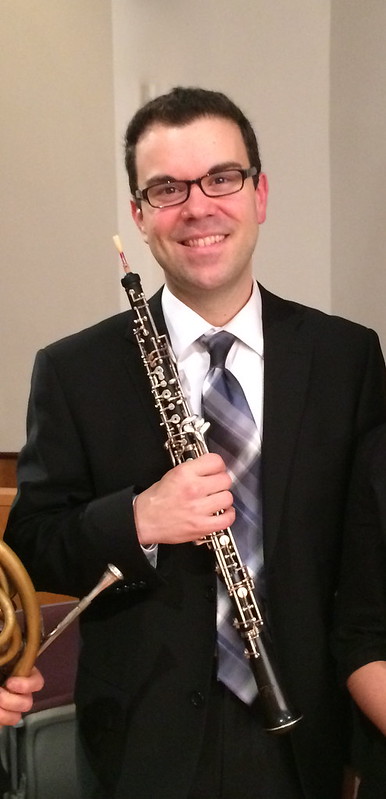 Yes! It’s cold outside! I was born and raised in South Louisiana, but I’ve lived in the Midwest since 2005. Winter here in Northern Michigan always takes me a bit by surprise — every year it’s different! But, I can’t deny that I love it. My husband and I try to get out into the snow and cold as much as possible — snowshoeing and hiking, mainly. The cloud cover starts to wear on me a bit by March, but that’s usually when we take a little trip to Louisiana to visit my family and see the azaleas and wisteria in full bloom.
I’ve noticed winter is typically when I find time to get most of the arranging and composing done for Manitou Winds. With evening coming so quickly this time of year, I brew a cup of coffee or tea and head to the piano bench to plan the coming year’s musical adventures. Right now, in fact, I’m working on the 2016 Winter Songs & Carols program. It is a  little strange to be thinking about the holidays in January and February, but the cold helps! I really have to seize the day before I get too busy with other things.
Other than music, I spend a lot of spare time planning and working in a fairly large web of gardens that I sketched out and began with James. Of course, we’re not done creating the gardens, but these things take time — and work! For the vegetable garden, we start most of the seedlings ourselves usually around February, and then things just get busier from there as the weeding, watering, and planting sessions get longer and more frequent into June. It’s a lot of work, but I enjoy the exercise and the excuse to be outdoors. I do get an inordinate amount of pleasure from growing and gathering a lot of our own 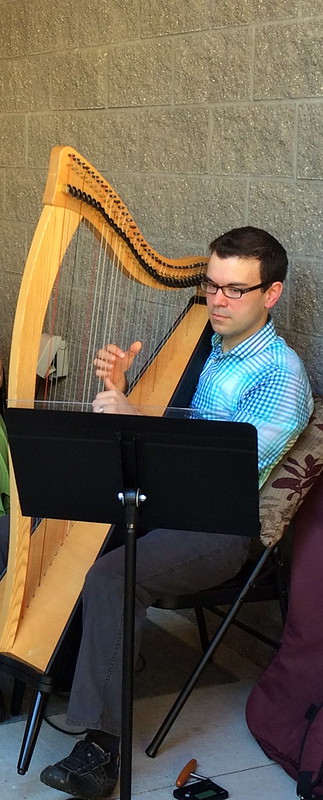 food — and preserving it. Yep, we can stuff! Jams, pickles, tomato sauces… it’s a little strange how much I enjoy filling up the pantry.
Before I picked the oboe back up and Manitou Winds was just this faraway idea in my head, I usually spent all of winter working on patchwork quilting and learning to speak Gaeilge (Irish… but that’s an ongoing story for another time). The garden usually kept me too busy to do much on my quilting projects or Rosetta Stone during spring and summer, but after all the canning started dying down in autumn, I’d pick things back up and usually finish a quilting project or two and master a few new units and verbs.
These days, I find the oboe is a very demanding presence. Keeping up with reeds, music, and ensembles has pretty much shoved quilting to the back burner. If I had more time, I think I’d still be quilting. It was tedious work, at times, but I really enjoyed the overall 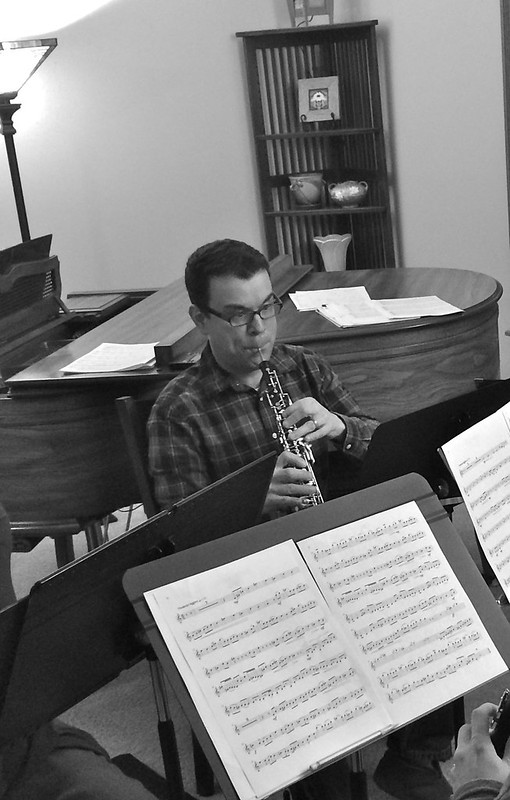 process. Stepping away from the fabric was a compromise in a lot of ways, but as long as I’m learning and enjoying what I’m doing it’s worth it.
I always said quilting reminded me of drawing or painting — two things I was never any good at. Working with all the little patches of fabric was my way of “painting”. If I’m honest, composing and arranging for Manitou Winds pretty much reminds me of quilting. There’s the tedium of the minute details within each measure and the process of actually getting these notes onto paper. Then, there’s the edits and rewrites when something isn’t quite what I wanted it to be, and the excitement that grows as the pieces gradually come together. And finally, there’s that moment when you can step back and see/hear the whole picture.
I still get nervous about premiering pieces — performing in general. But my nervousness is always overshadowed by the joy I feel in getting to share this music with the musicians (my friends) and eventually our audience. Keeping it all to yourself just wouldn’t be satisfying at all.
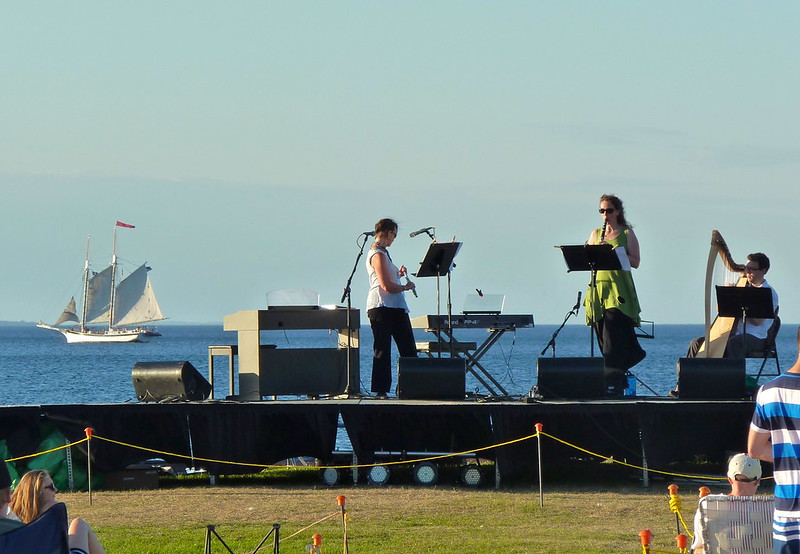
The same thing goes for food! Today I made two Irish-themed recipes to share at the potluck…
___________________________________________________________
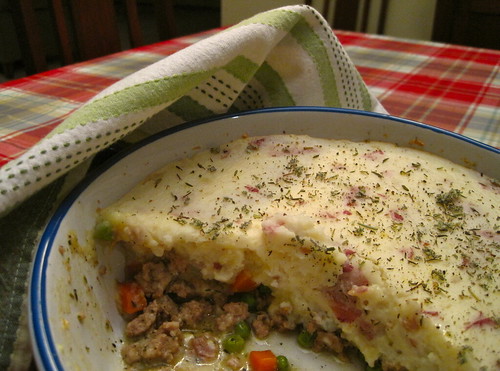
Shepherd’s Pie
Serves 4-6
One of my all-time favorite comfort foods! I prefer to leave the potato skins on (for color and fiber), but peeling them is okay too. To adjust the consistency and amount of the sauce, just adjust the amount of stock you add. There’s only enough cheese here to add flavor so be sure to use a sharp cheese.
 1 1/2 pounds red potatoes
2 tablespoons unsalted butter
1/2 cup low fat sour cream
Salt and freshly ground black pepper
1 pound lean ground meat (beef, pork, lamb, or turkey)
1/2 teaspoon dried rosemary
1 teaspoon dried thyme
1/2 teaspoon dried sage
1 1/3 tablespoons all-purpose flour
1 cup low-sodium beef or chicken stock (approximately, see above)
1/2 cup diced carrots
1/2 cup green peas
2 1/2 ounces Dubliner or sharp white cheddar cheese, shredded
Preheat oven to 350-degrees.
Wash potatoes and cut into 1″ cubes (unpeeled). Boil in salted water until fork tender; drain and return to pot. Add butter and mash into potatoes until nearly smooth. Add sour cream and mix thoroughly; add salt and pepper to taste. Cover and set aside.
In a medium skillet over medium-high heat, brown and crumble the ground meat seasoning with salt and pepper to taste; gradually add the rosemary, thyme, and sage. Sprinkle the flour over the mixture, stirring to incorporate; cook for 1 minute. Gradually add to the skillet approximately 1 cup of stock while stirring (the stock you add will determine how saucy 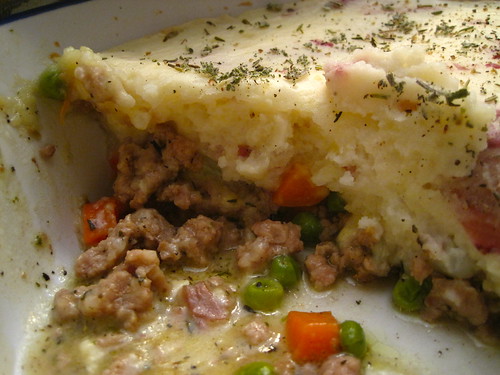 the “filling” of the pie will be); bring to a full simmer. Stir in diced carrots and peas and return to a simmer; cover and cook, stirring occasionally, for approximately 12 minutes or until carrots are fork tender and sauce has thickened. Season to taste with salt and pepper.
Pour the meat mixture into a 2-quart (preferably round) casserole dish. Top with cheese to make a thin layer. Spoon the mashed potato mixture atop the cheese and then spread evenly to completely cover; sprinkle with additional dried herbs and pepper, if desired. Bake for 20-30 minutes or until mixture is bubbly on bottom and potatoes are beginning to brown slightly on the edges. Allow to cool 5-10 minutes before serving.
___________________________________________________________
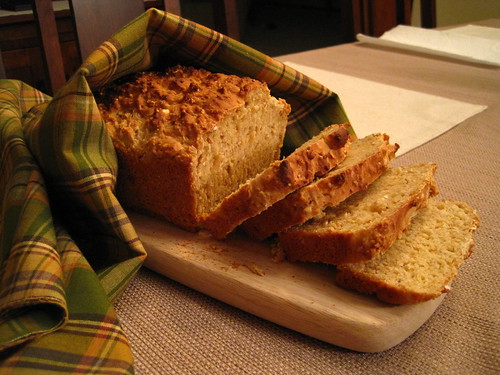
County Cavan Brown Bread
Yields 1 loaf (app. 12 slices)
I adapted this recipe from an authentic Irish cookbook. It’s the easiest and tastiest homemade bread you can bake — wholesome with oats and honey. Leftovers are excellent toasted and lightly buttered and served with breakfast or tea.
 1 1/2 cups all-purpose flour
1 cup whole wheat pastry flour or white whole wheat flour
1/2 cup quick oats
1/4 cup steel-cut oats
1 teaspoon Kosher salt
1 teaspoon baking soda
1/4 teaspoon baking powder
2 1/2 tablespoons honey
1 1/2 cups buttermilk
Preheat oven to 400-degrees. Lightly oil or butter an 8×4-inch loaf pan.
In a large bowl, combine the all-purpose flour, whole wheat pastry flour, quick oats, steel-cut oats, salt, baking soda, and baking powder; whisk together until uniformly combined.
In a medium bowl, add the honey and gradually stir in the buttermilk to dissolve the honey. Make a well in the middle of the flour mixture, pour the milk mixture into the flour mixture; mix just until thoroughly combined. Spoon batter into prepared loaf pan.
Bake at 400-degrees for 35-40 minutes or until loaf top is a dark golden-brown. Allow to cool in pan on wire rack for 10 minutes before turning out onto rack to cool.
___________________________________________________________
Looking for more recipes? Check out the other recent Woodwind Gourmet series:
Series I: Oboes, Oranges & Almonds
Our Virtual Potluck: Part II

The table is set, the buffet dishes are in place, the napkins are neatly folded, the kitties are on their best behavior. It’s time for the Manitou Winds Virtual Potluck!
You can put your coat over there and head over to warm yourself by the fire. I think I hear our next guest arriving…
 It’s Sam Clark, our flutist!
Yes! It’s cold outside! Born and raised in Michigan, Sam has lived in Northern Michigan for 35 years and counting. “I don’t mind the snow at all — love it. But, the constant cloudiness is a drag,” she says. The clouds don’t stop Sam, though. She’s likely to be out cross-country skiing, hiking, or camping with long-time partner, Bill, whether there’s sun or not!
“While through-hiking Zion National Park (over 70 miles) once, we went through the gamut of weather conditions and saw some amazing, strange scenery. The desert environment is very different — surreal to this Michigan girl, but I absolutely loved it,” she says.
Like most zephyrous flute players, Sam is adventuresome. Although, Sam says she doesn’t really agree with most of those  “musical stereotypes” that are the stuff of legend in practice rooms and green rooms.
“There are usually reasons for stereotypes in general,” she says, “but I’ve conducted and performed with musicians of many facets and can’t say I’ve been able to categorize any of their personalities based on their instruments. For instance, flutists are generally construed to be girly-girls… which I’m definitely not!”
From stereotypes to superstitions… Sam has something of a lucky charm in her flute case. “Well, it’s not really a superstition, just a comfort,” she explains, “My swab handkerchief was worn onstage by a dear departed friend at the Old Town Playhouse in 1985. I smile  at the thought that he’d appreciate me swabbing my spit with his costume!”
Active in the outdoors and on the music scene, Sam has a long history with Traverse City’s Old Town Playhouse wearing many hats — from the stage to the orchestra pit to the boardroom. In 2015, she conducted her 16th musical production with the theater in a highly successful run of Shrek: The Musical.
Why would she join a chamber group on top of everything else she’s built into her busy schedule? “I like the intimacy of the communication and connection of the personalities and musical characteristics of Manitou Winds,” she explains. “I love trying out new pieces — particularly those that Jason finds, arranges, or composes for us.”
Whether you’re a talker or a listener, a leader or a follower — it all comes out in rehearsal! In Manitou Winds, five personalities as unique as our five different instruments have to make a concerted (ahem) effort to collaborate in order to be successful. For chamber music, this is often a matter of verbal and musical communication with lots of non verbal cues thrown into the mix as well. Something truly musical happens when those independent elements come together to create a unified sound.

If afforded an ounce of spare time, other than doing more music and outdoor recreation, Sam says she’d probably do more reading. “I’d also like to get more involved learning about animals and working with rescue and veterinarian organizations,” she says, “and maybe learn how to cook!”

Actually, Sam can cook, she simply doesn’t have time very often. She’s much more likely to cook while sharing the kitchen with Bill. For today’s potluck, she’s brought a tasty lasagna to share. As semi-vegetarians, she and Bill consider this lasagna a special treat for those occasions when they have a carnivorous craving…
___________________________________________________________
Spinach & Turkey Lasagna
Serves 8
Sam says, “My trumpet-playing boyfriend improvises (yes, he’s primarily a jazz musician) while cooking, and is very good at it. This is one of my favorite meals for the two of us to snuggle up to in winter.” Using whole wheat lasagna, lower fat cheeses, and lean ground turkey, it’s a tasty, lighter version of a comfort food classic.
 1 tablespoon extra-virgin olive oil
3-4 large cloves garlic, crushed
1 medium onion, chopped finely
1 large carrot, chopped finely (app. 1 cup)
1 celery rib, chopped finely (app. 1/2 cup)
1 dried bay leaf
Sea salt & freshly ground black pepper
1 pound lean ground turkey
2-3 tablespoons mixed dried Italian herbs (basil, oregano, rosemary, thyme & marjoram)
32 ounces tomato sauce
6 cups chopped fresh spinach (or 10oz frozen spinach thawed and squeezed dry)
a large pinch of crushed red pepper flakes
16 ounces part-skim ricotta cheese
8 ounces part-skim mozzarella cheese, shredded (divided)
1 egg white (or 1/4 cup egg substitute)
9-12 whole wheat lasagna noodles
Preheat oven to 375-degrees. Bring a large pot of salted water to a boil.
Make the meat sauce: Meanwhile, in a large sauté pan or a 3-quart heavy-bottomed saucepan, heat the oil over medium-high heat. Add the crushed garlic; cook, stirring constantly, for 30-seconds or until very fragrant. Stir in the onion, carrot, celery, bay leaf, and a small pinch of sea salt; cook, stirring occasionally, until vegetables have softened and are just beginning to brown (app. 5-8 minutes). Add ground turkey and herbs, season lightly with salt and pepper; cook 5-7 minutes more, stirring to break up any large chunks. Stir in tomato sauce, spinach, and pepper flakes  and bring to a low boil. Lower heat, partially cover; simmer, stirring occasionally, for 20 minutes.
Make the cheese filling: In a medium bowl, combine the ricotta cheese, half of the shredded mozzarella, and the egg white or egg substitute; season lightly with salt and pepper.
To assemble: In a 13×9-inch pan, spread approximately 1/4 cup of the meat sauce (be sure to remove the bay leaf). Cook the lasagna noodles (3-4 at a time) in the boiling salted water for 4 minutes, stirring occasionally. Remove noodles with tongs or a slotted spoon and layer atop the thin layer of sauce. Spread 1/3 of the cheese filling atop the noodles. Top with 1/3 of the meat sauce. Repeat to form three layers. Top with the reserved shredded mozzarella.
Bake at 375-degrees 25-30 minutes or until bubbly and cheese is lightly browned. Allow to cool 10 minutes before slicing and serving.
___________________________________________________________
Looking for more recipes? Check out the other recent Woodwind Gourmet series:
Series I: Oboes, Oranges & Almonds
Our Virtual Potluck: Part I

The table is set, the buffet dishes are in place, the napkins are neatly folded, the kitties are on their best behavior. It’s time for the Manitou Winds Virtual Potluck!
Welcome! I’m so glad you could come. I think I hear our first guest arriving…
 Yes, that’s Christina Duperron, Manitou Winds’ bassoonist. I kinda assumed she’d be the first to arrive. Christina is always the first to show up for rehearsals, too. We double-reed folks tend to be that way: we have instruments to warm up, reeds to soak and test… lots of things to think over before we can begin.
Yes! It’s cold out there!! Christina has always lived in Northern Michigan and doesn’t envy the snowbirds one bit. “My favorite thing about a Northern Michigan winter is the snow!” she says, “There is also something amazing about how desolate and incredibly quiet it can be… lying there in the snow with my daughter making snow angels, looking up to watch the clouds going by.”
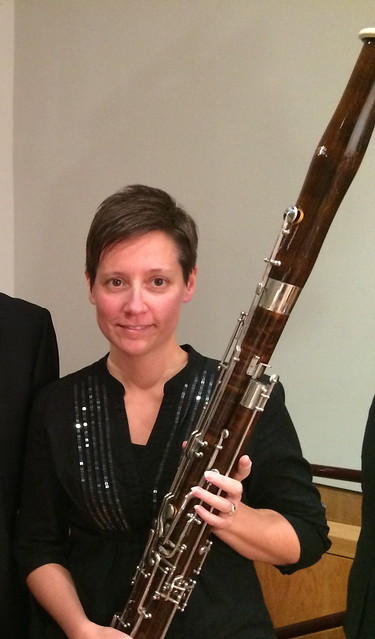 Christina owns and operates Duperron Designs, a decorating and interior design business in Benzie County. If she had more spare time, she would probably get back to making pottery — something she enjoyed in her college days. “My husband bought a wood lathe last year, so I think I’m going to try my hand at making turnings — it might satisfy my pottery interest. Maybe making some candlesticks or bowls would be nice!”
Between the demands of running her own business and making space for family time in the great outdoors, squeezing in time for bassoon practice can be challenging any time of year. “That’s my least favorite part about the chamber group experience: starting with all new music right after finishing a concert!” she admits, “It can feel like that pile of homework you keep putting off… but, once you dive into it, it’s not so bad!”
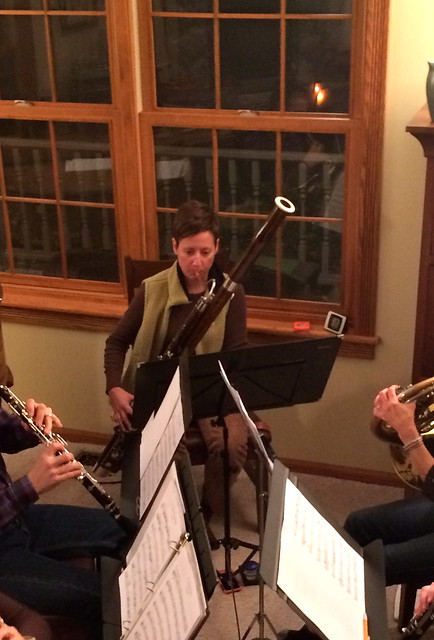 As the primary bass voice of Manitou Winds — whether the group is performing as a quintet or a trio — there’s rarely a spot in a performance where Christina isn’t either playing or counting rests just before playing! It’s a tremendous amount of responsibility, but she takes it all in stride — right down to the three-octave range she has to cover in our music.
She explains, “My favorite part about being in a chamber group is the challenging music and the chance for my instrument to be heard!” In larger groups, especially symphonic band, the bassoon’s part is often doubled by trombone, saxophone, bass clarinet, or a host of other instruments that blend well but often mask or completely block out the characteristic voice of the bassoon.

By contrast, each musician in a chamber group has a unique part and has freedom to make decisions about how the piece is performed. “I enjoy the freedom of interpreting the music as a group, being able to take liberties with solo sections, and just learning to listen to each other to figure out how our parts fit together,” she says, “It’s really all about eye contact and awareness of the other players — it’s almost like we are reading each other’s minds sometimes!”
Christina had no trouble coming up with a dish or two to bring to today’s potluck. She and her family eat most of their  meals at home, and she takes her work in the kitchen as seriously as her work on bassoon. “I work until 5 most days and I have a 4-year-old who needs to eat by 6pm! Especially on weekdays, pretty much everything I make has to be thrown together at the last minute,” she explains. Christina has a long list of standby recipes including chicken enchiladas, venison-barley soup, black bean and veggie sloppy joes… winter is all about those hearty comfort foods!
For today’s potluck, she brings an appetizer and a dessert…
___________________________________________________________
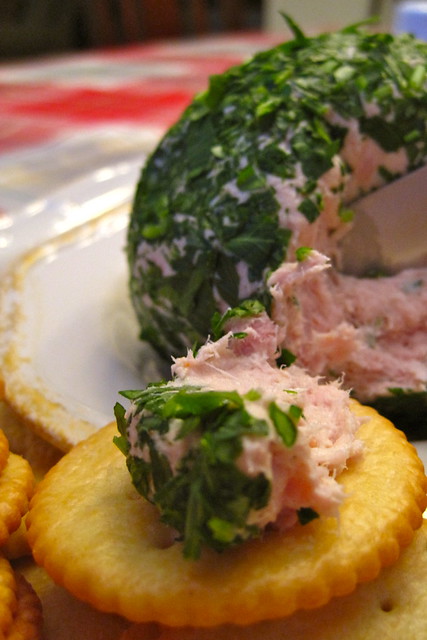
Ham & Cheese Spread
Serves 24
This is Christina’s favorite cheese spread recipe. “It’s always been a hit when I bring it to parties. One friend said she could eat a whole bowl of it!”
 8 ounces cream cheese or low-fat cream cheese
8 ounces chopped ham
1/4 cup chopped fresh parsley, divided
1 tablespoon minced green onion
1/4 teaspoon mustard powder
1/4 teaspoon Tabasco sauce
Combine all ingredients, reserving 2 tablespoons of the chopped parsley, in the bowl of a food processor. Pulse until ham is minced and thoroughly incorporated (scrape down the bowl if necessary).
To serve as a cheese ball: roll the mixture into a ball using a sheet of plastic wrap. Chill for at least two hours. Remove from the fridge and roll the ball in the remaining chopped parsley.
To serve as a cheese spread: spoon the mixture into a serving dish and top with remaining parsley as desired. Serve chilled with assorted crackers.
___________________________________________________________
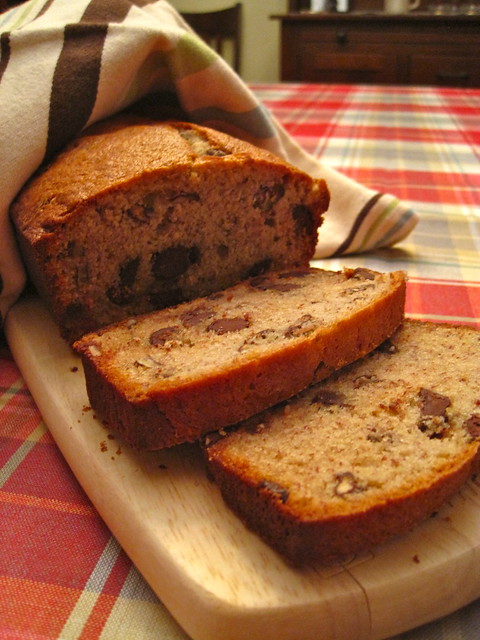
Banana Split Bread
Serves 12-14
Christina says this is no ordinary banana bread; the chocolate chips make it an extra special treat. Most banana breads taste best when allowed to completely cool and rest about a day before slicing… if you can wait that long!
 2 cups all-purpose flour
1 teaspoon baking powder
1/2 teaspoon baking soda
1/4 teaspoon sea salt
8 tablespoons unsalted butter, softened
1 cup granulated sugar
1 large egg
1 cup mashed ripe bananas (app. 2 large)
3 tablespoons milk
1 cup (6 ounces) semi-sweet chocolate chips
1/2 cup chopped pecans, toasted
Preheat oven to 350-degrees. Lightly oil a 9×5-inch loaf pan. Line with parchment and oil the paper as well. Set aside.
In a medium bowl, combine the flour, baking powder, baking soda, and sea salt.
In a large mixing bowl, cream the softened butter and sugar until light and fluffy. Beat in the egg. In a small bowl, combine the mashed bananas and milk. Add the flour mixture to the creamed mixture alternately with the banana mixture, mixing well after each addition. Fold in the chocolate chips and toasted pecans.
Pour into prepared pan. Bake at 350-degrees 60-70 minutes or until a toothpick inserted in the center comes out clean. Allow to cool in pan for 10 minutes before removing to a wire rack to cool completely.
___________________________________________________________
Looking for more recipes? Check out the other recent Woodwind Gourmet series:
Series I: Oboes, Oranges & Almonds
Winter Songs & Carols: A Magical Evening
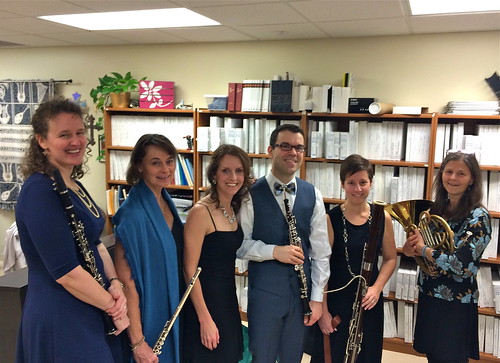
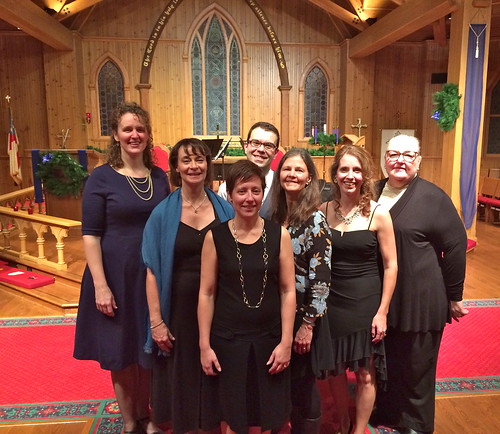
 Manitou Winds’ premiere concert, Winter Songs & Carols, was a splendid event! We were delighted to share our music with so many of our friends, colleagues, Facebook fans — and even some new faces! We are grateful for all of your support and enthusiasm as we continue to embark on this musical journey. We hope to make Winter Songs & Carols an annual event.
When looking for a venue for our first concert, we settled almost immediately on Grace Episcopal Church. What a fantastic venue — such a warm acoustic and beautiful woodwork. It was just right for the kind of concert we wanted to create. Though it is a spacious sanctuary, the intimate nature of chamber music soon filled in the spaces, drawing everyone in with the sounds of winter and the holidays.
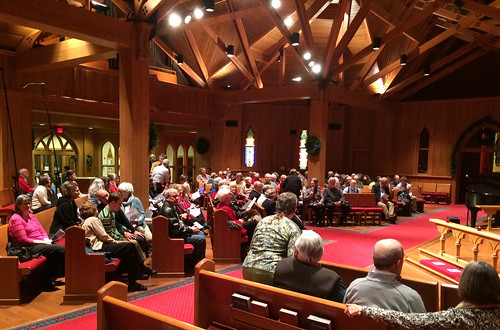

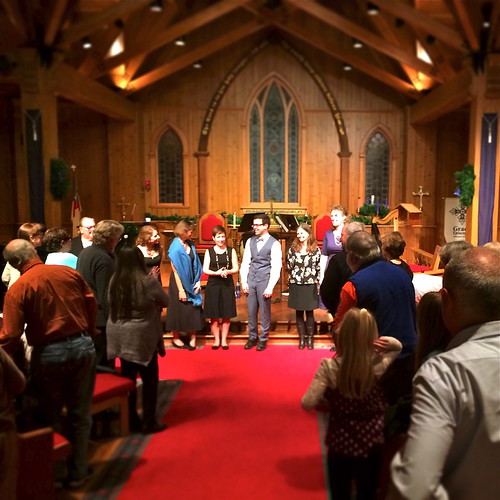
Our goal was to create a concert program exploring the many moods of winter — going beyond Christmas to also celebrate wintertime and its many facets. In order to do that, we collected repertoire in a variety of styles using all sorts of combinations of instruments.

Of course, preparing the program meant a lot of work — months of researching, arranging, and rehearsing. It was interesting to find ourselves contemplating winter in late August, for example! The work was pure bliss, however, as we fell in love with this music almost immediately.
One our favorite moments of the evening was the world premiere of Three Celtic Carols — an original composition completed in 2015. Music written expressly for wind quintet is rare enough, but the three carols themselves were fun to explore and share.
We also celebrated the coming of the longest night of the year (Winter Solstice) with an ethereal quartet arrangement of Johnny Cunningham’s King Holly, King Oak.
For this year’s concert we had the honor of working with a fabulous vocalist: Susan Hatt Johnson. Susan’s contribution to the program was immense. Through her stage presence and versatile voice, she introduced the audience to a new character with each song (even doing a quick onstage costume change!).
[youtube https://www.youtube.com/watch?v=rW1J1dpdj44&w=560&h=315%5D
For a surprise twist, we enlisted the talents of Teddy House, a theater enthusiast and founding actor with the Glen Arbor Artists Association’s Reader’s Theater. Instead of an intermission to give our embouchures a break, the audience was transported to various wintry scenes via Teddy’s readings of poetry and prose.
We’re happy to announce that you — our audience — raised over $630 for Grace Episcopal Church’s Friday Community Lunch ministry. Thank you so much! We’re told the organization gladly receives donations of time and materials throughout the year, but they rarely receive a monetary gift of this size… and, of course, a donation during this time of year is an immense help.
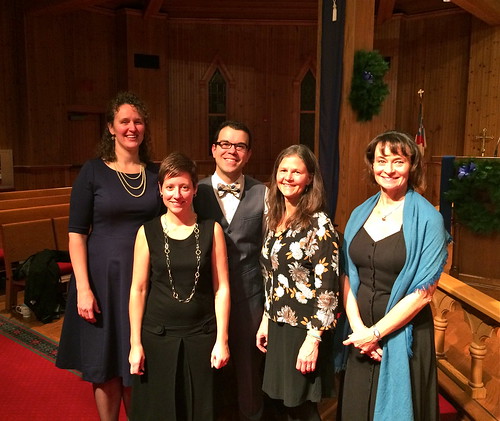
Winter is taking its time settling in to northern Michigan, it seems. By this time, last year, we had snow on the ground and had said goodbye to 50s and 60s weeks ago! Nonetheless, we hope Winter Songs & Carols was a soothing start to your season. We hope to see you at our next concert.
Winter Songs & Carols: Susan Hatt Johnson
This post was written in preparation for our December 2015 Winter Songs & Carols program.
Winter Songs & Carols will be Manitou Winds’ first-ever concert — one they hope to make an annual tradition in Northern Michigan. It’s a concert in exploration of the many facets of winter — from the holidays we look forward to each year to the more mundane aspects of a season that tends to get a lot of bad press. Each year, Manitou Winds plans to  gather music — new and old — to celebrate winter in new and exciting ways.
For this year’s event, Manitou Winds is tremendously honored to be working with the glittering talent of none other than Susan Hatt Johnson of Frankfort, MI!
If you’re a lover of music and the arts in Northern Michigan, it’s likely you have already experienced Susan’s dynamic stage presence and powerful performances. In addition to singing and dancing with the sensational SwingShift (a local swing band) in various hot spots around Northern Michigan, she has made recent guest performances in Traverse City with both The Dance Center, Inc. and Encore Winds, belting out demanding diva ballads such as My Heart Will Go On and Where Are You Christmas.
Susan has also graced the stage in two recent productions with Traverse City’s stellar Old Town Playhouse. In 2013, she starred as Fantine in OTP’s production of Les Miserables.
[youtube https://www.youtube.com/watch?v=7qm3qIoQT_s?t=6m53s&w=475&h=267%5D
Then, in spring 2015, she starred as Gingy/Sugarplum Fairy in the OTP production of Shrek: The Musical where she was joined onstage by her husband, Brian Johnson, who starred as Lord Farquaad:
[youtube https://www.youtube.com/watch?v=Nc6_F_f0dLQ?t=8m48s&w=475&h=267%5D
Manitou Winds is delighted to partner with Susan for Winter Songs & Carols. For this performance, Jason has arranged four unique songs to highlight Susan’s remarkable versatility, pairing her with the members of the ensemble in imaginative ways.
“These four songs are likely going to be a surprise for our audience,” he says, “Most people would expect purely Christmas music, but we’re taking this in a different direction.” Jason won’t disclose what four songs Susan will be singing, but he did mention Sarah McLachlan, Tori Amos, and Loreena McKennitt.
Manitou Winds’ Woodwind Gourmet had an opportunity to chat a bit with Susan after her recent rehearsal.
WWG: Did you always know you wanted to be a singer/actress? Did you have training as a vocalist?
Susan: I have been singing for as long as I can remember — even as a young child. My parents bought me an old upright piano when I was eight years old. I started acting in junior high. Then, in high school, I started writing my own music. I always knew I would do something with music, though I made a pact with myself (right around the time I started private lessons at age 15) that I would not major in music/theater, so I’d have some other career skill to fall back on. But, while at MSU, I did continue training in opera and musical theater.
WWG: You were originally from Muskegon. You went to MSU. You and your family now live in Frankfort. Obviously you’re a Michigander through and through! What’s your favorite part about living in Northern Michigan?
Susan: Of course I’d have to say it’s the people of Northern Michigan. But, definitely also the arts, here. And you can’t forget Lake Michigan.
And, as you’d expect, he didn’t let her get away before asking what Susan’s favorite wintertime dinner is…
___________________________________________________________
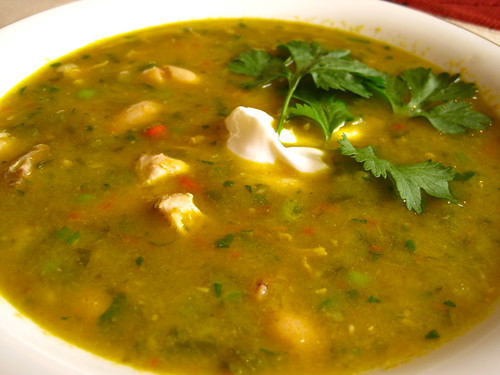
White Chicken Chili
Serves 6-8
3 pounds bone-in chicken thighs, trimmed
salt & pepper
1 tablespoon oil
 3-4 hot chili peppers (a mix of varieties)
4 poblano chiles, stemmed, seeded, & chopped finely
2 large yellow onions, chopped finely
8 garlic cloves, minced
2 teaspoons ground cumin
1 1/2 teaspoons ground coriander
2 15oz cans cannellini or navy beans, rinsed & drained
3 cups low-sodium chicken broth
3 tablespoons fresh lime juice
1/4 cup minced fresh cilantro
4 scallions, sliced thinly
Season chicken thighs with salt and pepper. Heat oil in Dutch oven over medium-high heat. Working in batches, brown the chicken thighs (about 4 minutes per side) then transfer to a plate; remove and discard skin.
Meanwhile, remove and discard ribs and seeds from 2 hot chili peppers; mince and set aside. (Note: you can leave all the seeds and ribs in if you prefer your chili spicy!)
After removing the browned chicken, pour off all but 1 tablespoon fat from the Dutch oven (add additional oil if necessary), and reduce heat to medium. Add minced chili peppers, chopped poblanos, onions, garlic, cumin, coriander, and 1/4 teaspoon salt. Cover and cook, stirring occasionally, until vegetables have softened (about 10 minutes).
Transfer 1 cup cooked vegetable mixture to a food processor or blender. Add 1 cup beans and 1 cup broth; process until smooth. Return this mixture to the Dutch  oven along with the remaining 2 cups broth and the browned chicken thighs. Cover and simmer, stirring occasionally, for 25 minutes or until chicken registers 165-degrees.
Transfer chicken to a large plate. Stir in remaining beans and continue to simmer, covered. When cool enough to handle, shred chicken into bite-sized pieces; discard bones. Stir the shredded chicken, lime juice, cilantro, and scallions into chili and return to simmer. Allow flavors to mingle for another 10 minutes or so. Season with additional salt and pepper to taste. Serve with a dallop of sour cream and a side of corn muffins or crusty bread.
Three Celtic Carols

This post was written in preparation for our December 2015 Winter Songs & Carols concert. For information about our next Winter Songs & Carols program or our other seasonal performances, visit our Performances page.
While putting together arrangements and selections for Manitou Winds'”Winter Songs & Carols”, I sought pieces that would be a departure from what our audience might expect to hear during a season usually filled with Christmas concerts. Part of that departure was accomplished by selecting tunes that have a stronger connection to the celebrations of Advent or Winter Solstice than Christmas. But, I also sought out Christmas tunes that were perhaps less popular or overshadowed.
While researching, I noticed a lack of Celtic representation in literature for winds. Joining my search for overshadowed tunes with my love of Celtic music, I became inspired to create a small suite of carols with Celtic origins written expressly for wind quintet.
Three Celtic Carols
When people think of Celtic music, they most commonly think of Ireland or Scotland. However, the Celts inhabited quite a large area of Europe in ancient times. Roaming the countryside of northern Spain and France, for instance, you can find prehistoric Celtic sites that very closely resemble those found in Ireland and Scotland. Celtic influence in those areas is unmistakable and continues into the modern era. So, while these tunes may be only partly Celtic when examined closely, they are unarguably influenced by the Celts.
Movement I: Jesous Ahatonhia
- The lyrics of this carol are believed to have been written by Father Jean de Brébeuf in 1642 while he was working as a missionary in New France,
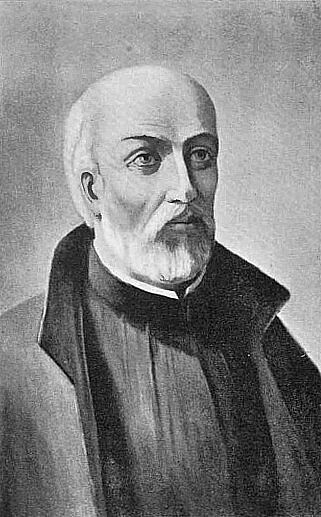 ministering to the Huron (Wyandot) tribes.
While it’s now common to think of missionaries from the days of colonialism as mere invaders, Brébeuf’s earnest and compassionate efforts to learn the language and culture of the Huron people is compelling. Rather than attempting to convert them to Catholicism by forcing them to learn French, he translated French texts into Huron.
Naturally, Brébeuf wrote his carol in Huron, the lyrics transporting the story of the Nativity from Bethlehem to the New World. Rather than a manger in a stable, Christ was born in a lodge of broken bark, swaddled in rabbit’s fur. The three Magi were hunters who brought gifts of fox and beaver pelts rather than frankincense and myrrh.
‘Twas in the moon of winter-time
When all the birds had fled,
That mighty Gitchi Manitou
Sent angel choirs instead;
Before their light the stars grew dim,
And wandering hunters heard the hymn:
“Jesus your King is born, Jesus is born!” — English translation of the first stanza
The carol’s Celtic connection (though admittedly murky) lies in Brébeuf’s birth in the Normandy region of France which had long been a part of the Celtic nation 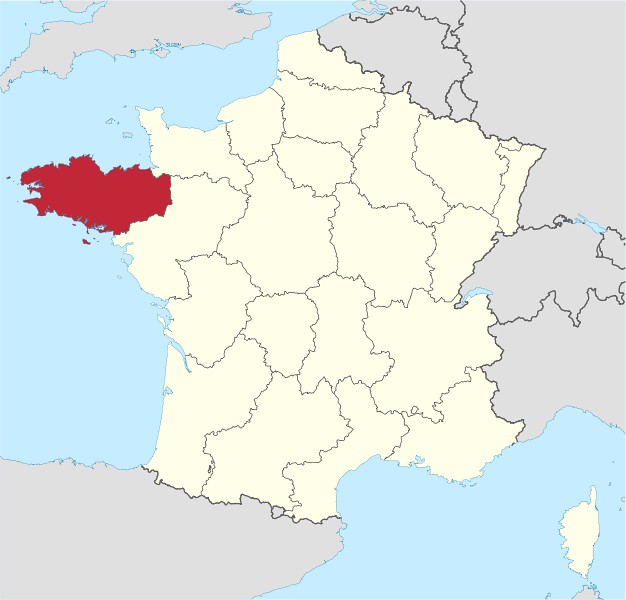 of Brittany (see map) and had strong Celtic influence even once the two regions were separated politically. The folk tune which he adapted for his lyrics (Une Jeune Pucelle) may have directly originated in Brittany as well, but due to its folk origin this cannot be said for certain.
Tragically, Brébeuf and many of his converts were eventually captured, tortured, and killed by the Iroquois. Musically, I find it difficult to marry peace and hope with danger and violence! So, in my treatment of this carol, I sought to portray for the audience the sense of danger and the unknown Father Brébeuf and his companions must have felt while journeying across the Atlantic to minister to the Huron people.
Movement II: Carúl Inis Córthaidh
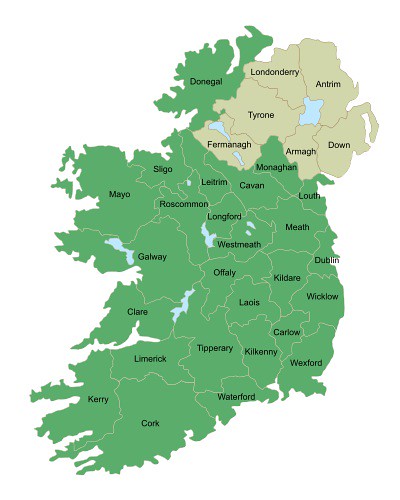
- The tune and lyrics for this carol undoubtedly originated in Ireland but a precise date for its origin cannot be pinpointed. Both the lyrics and the tune may be as old as 12th century or as new as 18th century. Whether the lyrics were originally written in Irish Gaelic or English is also debated since the only Irish version that can be found contains a rhyming scheme more indicative of 19th century Irish than medieval Irish poetry.
We do know the tune was transcribed by William Grattan Flood, organist and musical director at St. Aidan’s Cathedral in Enniscorthy, County Wexford, directly from from a local Irish singer. Flood submitted the carol for publication in the Oxford Book of Carols in 1928. Its publication in that volume has thankfully led to the carol’s preservation and eventual spread around the globe through many other hymnals that followed.
I have always found the tune intriguing, musically, because of its modal inflections (depending  on its treatment, it hints at Mixolydian mode). However it holds special meaning to me since it’s the only traditional Christmas carol that is 100% Irish (both the tune and the lyrics having originated in Ireland).
For my treatment of this carol, I began by depicting a blustery landscape on the southeastern coast of Ireland — lots of fluttering in the flute and clarinet! As the waves crash upon the coastline (horn and bassoon) and we drift farther inland, we hear the intoning of a cathedral organ beckoning us to come out of the driving wind. Here, a single chorister (oboe) is singing the carol tune and is eventually joined by the rest of the choir. Though the movement begins as boisterously as the first movement, a much more contemplative mood is revealed. As the lyrics suggest, the tune also beckons us to ponder the mystery of the Nativity.
Movement III: Moita Festa
- This tune originates from northwestern Spain’s Galicia region. Galicia was settled by the Celts in ancient times and their influence on the region’s folk
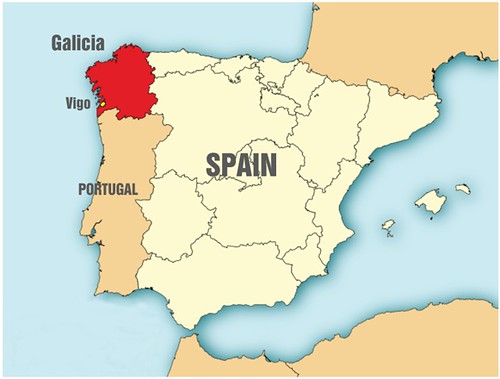 music is quite evident even though the Celtic language in the region has all but died out.
The carol, which has no lyrics traditionally, was composed in 1829 by Joseph Pacheco, music director at the Mondoñedo Cathedral in the province of Lugo (Galicia). The tune name translated from Galician means “many festivals”. Pacheco composed the tune especially for Christmas celebrations — traditionally the only time of year in which the Celtic folk instruments were allowed to join the church orchestra. Traditionally, the tune is presented in a theme and variations form with built-in repeats as the tune goes through each variation.
The Galician musician most responsible for bringing this tune to our modern-day attention is Carlos Núñez. For his 1996 album, The Brotherhood of Stars, he created an arrangement entitled Villancico Para la Navidad de 1829. His recording popularized the tune and has led to many other arrangements and performances by Celtic 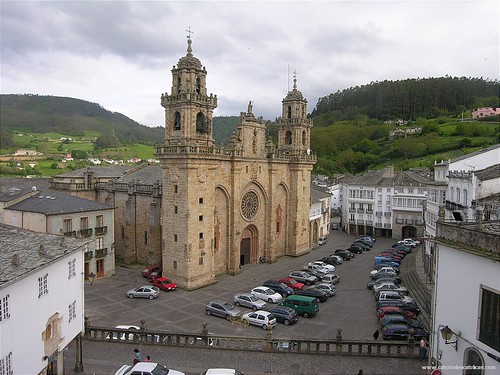 musicians outside of Galicia.
I enjoy the mental image of the eager folk musicians who were allowed once a year to add their best musical offerings to worship services. Since those instruments are not part of a wind quintet, I used the tune to depict a young boy awakening on Christmas morning, joyously spreading Christmas tidings through a Galician village as he skips and bounces along his way to the Cathedral for mass. As he makes his merry way, he is joined by more and more villagers who sing along in their unique character to his tune. By the conclusion, we’ve arrived at the center of the village as the great doors of the Cathedral are about to open onto a joyous cacophony of voices and livestock.
Aside from their Celtic roots, what unites these three tunes is that each served as a musical bridge to overcome some sort of divide — whether the differences were linguistic, geographic, or simply cultural traditions. In their own time and in their own way, each of these tunes served to unify people during Christmas.
UPDATE: You can now hear the entire suite of carols on our debut album: First Flight! Visit the Manitou Winds Web Store to order your copy today.
Winter Songs & Carols: The Art of Collaboration
 You don’t have to look very hard to find folks in Northern Michigan who are proud to live and work here. The area is teeming with artists of all sorts — drawn here for the sense of community, the easy-to-find solitude, and of course the beautiful natural scenery that’s the backdrop for all four seasons.
Each musician in Manitou Winds feels a deep connection to Northern Michigan. We each exhibit this connection in our own personal ways. For most of us, it’s clear in our choice of outdoor sports — hiking, biking, water skiing, boating, etc. But, our love of Northern Michigan and its four seasons has a deep resonance in the music we create as well.
Rather than a celebration of the holiday  season, our concert on December 5 (Winter Songs & Carols) will be an exploration of a season that tends to get a lot of “bad press”.
Winter is not always an easy season to love. Some of our favorite restaurants and stores close up. A few dear friends fly the nest for warmer climes. The sun is barely up before it starts to go down again — if you actually get to see the sun! And the snow… well, let’s just say you don’t want to cheer too loudly about news of an approaching snowstorm. You’re liable to have a snow boot aimed at your forehead.
But, winter’s not just about those things that we give up — the departure of all those summer comforts. It’s also about those things that we gain. Winter brings a very special kind of quiet to nature. That unique peace and quiet can also come to us if we let it. The songbirds are mostly gone and we’re left with the sound of  pine needles catching the wind, the knocking of branches, the scurrying of forest critters. Suddenly, these small voices are brought to our attention.
Winter may make the outdoors less hospitable for some, but think of the warm comforts we can enjoy indoors — cherished time with friends and loved ones. And think of winter’s beauty — more than just a silver lining in the clouds! When the sun breaks through on a bitterly cold winter’s day, you find yourself squinting at a world covered in silver, gold, and azure… maybe the inconvenience of the season isn’t too much to bear?
The beauty of a Northern Michigan winter… it’s why we had the idea to explore winter in music. It’s also why we came upon the idea of using local Michigan art to promote all of our concerts. We happened upon some of Vivi Woodcock’s lovely work during a summer weekend trip to Petoskey. In her beautiful watercolor, Solitude, I could so clearly see the beauty of winter that we’re hoping to convey in our concert.
Vivi is co-owner and curator of the Northern Michigan Artists Market gallery in Petoskey. The gallery is always a great place to explore, featuring artwork in many different forms from more than 85 different Northern Michigan artists.
Vivi’s own artwork is a combination of printmaking, collaging, and painting using various water media and other natural materials. Through the building of layers and the use of texture, she expresses the colors of nature that she loves.
She studied art at the University of Michigan and has since created works for competitive exhibits and shows. She also works as a contract artist, designing logos, posters, stationery, and has illustrated books and catalogs.
 When asked about her artistic philosophy, Vivi says, “Continual experimentation yields new ways to express the lively spirit and nature’s gifts I see in daily life.”
We certainly see that lively spirit present in her work — and you can too! Vivi very generously allowed us to use Solitude for our concert poster. To see more of Vivi’s work, you can visit the Northern Michigan Artists Market online. Better yet, you can stop into the gallery, talk with Vivi, and see her work in person.
Collaborating and learning from one another is probably the most rewarding part about any artistic endeavor — whether you’re collaborating with fellow musicians to express the fullness of a musical line, or you enlist the help of a visual artist to help the audience fully visualize a dramatic concept. We look forward to being inspired by more Northern Michigan artists and showcasing their impressive work.
For more information about Winter Songs & Carols, visit our Performances Page. For even more updates and insights, you can like us on Facebook.
Two Unique Quartets
When Manitou Winds performs its first-ever concert on December 5, 2015, it will be an evening of several premieres. Two of the pieces on the program, in particular, are quartets which were specially arranged for our concert.
The first and probably most familiar of the tunes is In the Bleak Midwinter by Gustav Holst (1874-1934). 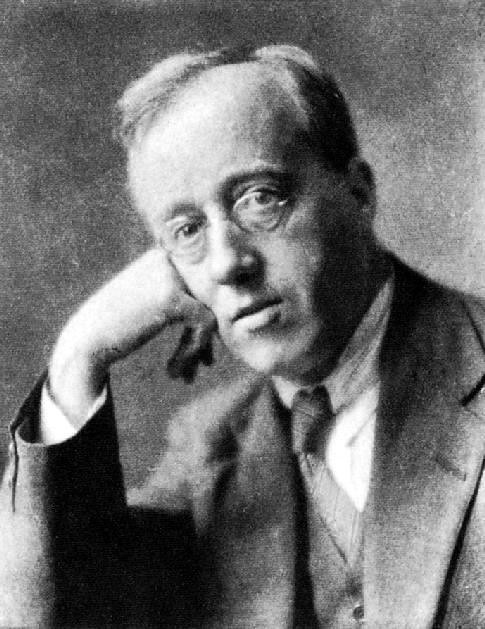 Historians believe it was composed in 1904 or 1905; one of three hymns Holst composed at the request of Ralph Vaughan Williams, musical editor of the English Hymnal (published in 1906). The original manuscript was lost, unfortunately, but correspondence between Holst and Vaughn Williams gives us a reasonable timeline.
The lyrics Holst was asked to set to music were written quite a bit earlier by the English poet Christina Rossetti (1830-1894). Rossetti initially wrote the poem in 1872 for publication in an American magazine (Scribner’s Monthly), but sadly it remained unpublished until 1904, some ten years after her death.
- In the bleak mid-winter
Frosty wind made moan,
Earth stood hard as iron,
Water like a stone;
Snow had fallen, snow on snow,
Snow on snow,
In the bleak mid-winter,
Long ago.
Our God, Heaven cannot hold Him,
Nor earth sustain;
Heaven and earth shall flee away
When he comes to reign:
In the bleak mid-winter
A stable-place sufficed
The Lord God Almighty,
Jesus Christ.
Enough for Him, whom cherubim
Worship night and day
A breastful of milk
And a mangerful of hay;
Enough for Him, whom angels
Fall down before,
The ox and ass and camel
Which adore.
Angels and archangels
May have gathered there,
Cherubim and seraphim
Throng’d the air,
But only His mother,
In her maiden bliss
Worshiped the Beloved
With a kiss.
What can I give Him,
Poor as I am?
If I were a shepherd
I would bring a lamb,
If I were a wise man
I would do my part,-
Yet what I can I give Him
Give my heart.
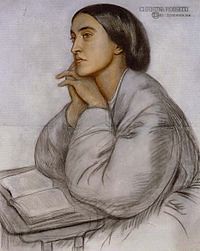 Holst’s compositional prowess was put to the test since the poem’s lines are very much irregular, not easily yielding to predictable meter. Magnificently, however, Holst’s melody manages to smooth over those rough places, adding poignancy to the text.
The hymn, now published in many Christian hymnals around the world, is regarded as one of the most evocative and yet introspective hymns about the Nativity. More than a mere retelling of the story of the Nativity, the text transports the manger to a snowy landscape, beckoning singer and listener to visit and ponder the scene rather being a mere spectator.
In taking on this beloved carol for Manitou Winds, I sought to capture the essence of both Holst’s melody and Rossetti’s text even though no one would be singing. Accordingly, I chose what is arguably a very non-traditional quartet of instruments. To begin, I selected what I believe to be the warmest trio from within wind quintet (oboe, clarinet, & bassoon). Then, I knew a guitar’s gentle meandering would add an unmistakable sentimental quality befitting the last stanza in particular (my personal favorite). Adding a stringed instrument to the mix also assured the wind musicians would have ample chance to breathe!
Moving from Britain to Scotland, the other quartet on December’s program is a never-before-transcribed work by the late fiddler Johnny Cunningham (1957-2003). King Holly, King 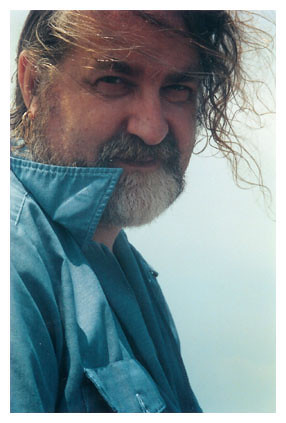 Oak was recorded in 1995 for the Windham Hill Sampler “Celtic Christmas” as a quartet for fiddle, oboe, harp, and double bass. I always cherished the tune and futilely sought pre-existing arrangements of the piece. As best I can tell, nothing about the piece was ever committed to paper in published form. It exists solely as a recording. Seeing as how our program is in exploration of the many facets of winter, I knew the piece — especially its association with Celtic mythology — would fit right in.
The infinite battle between darkness and light, cold and warmth, winter and summer, is a common thread in both Celtic folklore and ancient Celtic religion. Even modern, Neopagan religions have adopted these elements in some form. King Holly and King Oak are mythological figures who each represent one half of the year. King Holly represents the dark half of the year (we might say autumn and winter) while King Oak represents the bright half of the year (spring and summer).
The kings continually battle one another throughout the year. While neither is more virtuous than the other (i.e., good vs. evil), neither is ever fully victorious. The Oak King is his strongest at Midsummer while the Holly King is his strongest at Midwinter. According to the mythology, neither king could truly exist without the other; they are essentially two parts of a whole.
 Cunningham composed a beautiful melody to represent each king. King Holly (often described as a fore-runner to the modern day Santa Claus — both in wardrobe and in demeanor) is represented by the almost chant-like melody in harp over the double bass. King Oak (often portrayed as a fertility god — a giant, green lord of the forest) is given a lush, almost pastoral-like presence on the oboe accompanied by the rest of the ensemble. Through Cunningham’s juxtaposition of these two melodies, the listener can envision not only winter and summer, but also the beautiful transitions — the rise and fall from power — each season brings to nature via the winning and losing of the kings’ battles.
For my arrangement, I wanted to stay as true to Cunningham’s original as possible while still working within Manitou Winds’ instrumentation possibilities. I assigned the fiddle’s lyrical and soaring lines to the flute. I gave the oboe’s role to the clarinet. I took some liberties in order to work the double bass’ haunting presence into a part for bassoon (which obviously has an entirely different range and musical character). Lastly, the harp part on the recording was largely improvised, so I made an effort to keep the character of the original harpist’s performance while adding some accompaniment in the absence of the double bass.
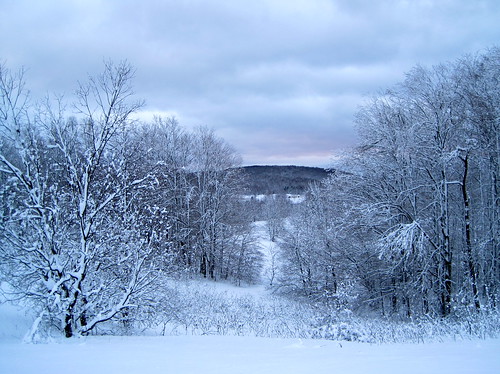
We hope both of these quartets will present for our audience alternating views of winter’s character: Rosetti’s image of the miraculous Nativity set in the darkest, coldest part of the year and Cunningham’s portrayal of the never-ending battle between winter and summer.
Woodwind Gourmet: Jason’s Müesli

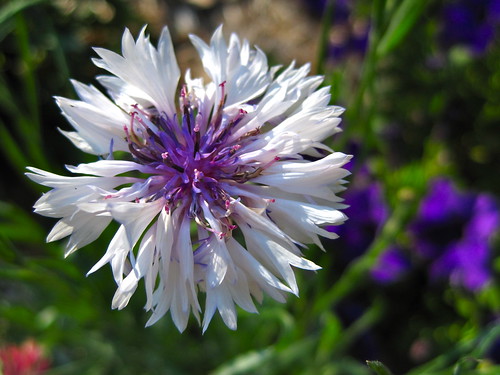 I have always been hesitant to call myself a composer. Looking through scraps of manuscripts saved from my college years and my high school journals, it’s obvious I’ve always aspired to be one. Thankfully, it wasn’t some misguided pursuit of fame or fortune that drove me to compose. It was a spark of inspiration that often seemed to come out of nowhere — a brisk fall breeze, a bumpy bus ride home from school, being afraid of the dark — all of these things eventually transcribed themselves in my head as tunes needing to be written down.
As a kid, I composed tunes on my tiny Casio keyboard; I never wrote them down, I just kept them in my mental repertory. In early high school, I began creating my own staff paper — one line at a time — using a ruler, a pencil, and some typing paper. It would be an embarrassingly long time before I discovered or had opportunity to buy manuscript books (where the staves are already printed for you!). Between my slow, uneducated process and my unending obsession 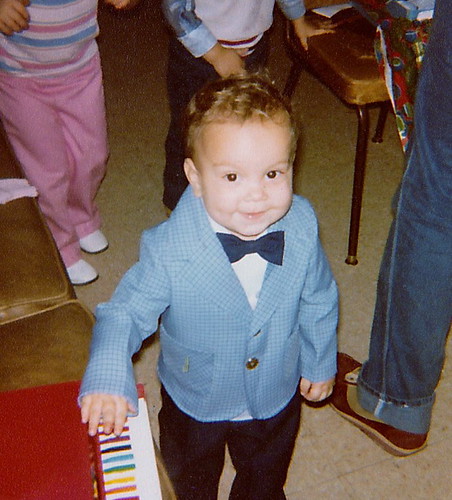 with perfectly parallel lines, it’s a wonder I ever committed anything to paper at all!
All of this scribbling eventually led to an event that forever changed my life. On October 23rd, 1996, one of my compositions was performed by a local university’s wind ensemble. My high school band director, who loaned me his old orchestration books (most of which flew right over my head at the time), urged me to enter a national composition contest and arranged for my piece to be recorded.
To properly set the scene, I should also mention I’d set aside my saxophone a few months earlier to start playing oboe (poorly). Nonetheless, I had great affection for the oboe and featured it rather prominently in my composition. Just days before the recording session, the conductor called my band director to inform us the university’s oboist would not be able to perform for the recording. He was wondering if I would perform with the group. Suddenly, writing that big oboe solo in the opening few measures of the piece seemed less than inspired. Did I want to perform oboe on the recording? I wasn’t sure I wanted to play oboe ever again! But, it was my oboe or no oboe, so I agreed.
The big day came and I was onstage in the massive recital hall with all of these college people. It was my music sitting on their stands (all the lines were perfectly parallel). I had my cheap oboe reed and my school’s janky student-model oboe in my lap. I was trying to keep my cool while the musicians were warming up. I could hear random bits and pieces of my composition flying all over the place.
The pianist came over to me and very politely mentioned that — for my next piece — I should be sure all the beats line up together in both staves for the piano part. I was wide-eyed 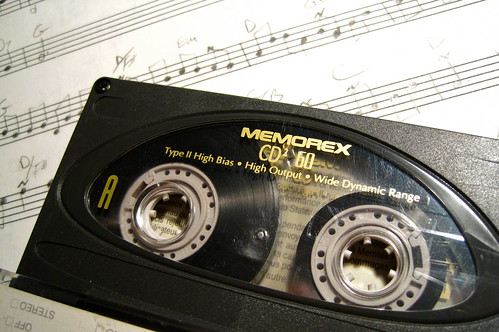 and nodded in agreement… in time, I would also learn that dots always go to the right of the note-head and flags always fly to the right regardless of which direction the stem is pointing (or which way the wind is blowing).
Finally the conductor gave that first downbeat…
For as long as I live, I’ll never forget the feeling. It was as though the room was spinning while sound was coming from all around me — not just any sound, but a “living sound”. It was more than sound, it was colorful and vibrant — almost tangible, as if every particle in the air was vibrating, coming to life, glowing. The sound was more alive than anything I’d been able to imagine while making all those scribblings on my homemade staff paper.
When the time came, I played the oboe solo to the best of my ability… my warbly, reedy, sharp, unrefined ability. As much as I should have been afraid, there was an energy inside that swirling sound that buoyed my sunken confidence, overshadowing my worries about how unqualified and unworthy I was. Music really is a miraculous thing.
I didn’t win the competition, of course. I didn’t even get an honorable mention. It was a national competition. I was from a very small public high school (fewer than 300 students). I’d never had an opportunity to write a large-scale piece before; my high school band was never more than about 25 students. I’d never had a music theory class or used music software. I had so much to learn! Rather than being disappointed, however, I was hooked: the spark from that first downbeat forever branded me a composer.
I listened to the recording every day for a long time. I kept wanting that feeling of the initial downbeat to come rushing over me again. I quickly learned it is a very elusive feeling, one a recording cannot capture. When I listen to that cassette recording, now — almost 20 years later — that piece, that day, that oboist, all seem so distant, unreal. I also understand the biting, cringing feeling of regret and remorse that drives some composers to destroy their early compositions!
Fortunately, among the musicians of Manitou Winds, I have found an opportunity most composers would envy: 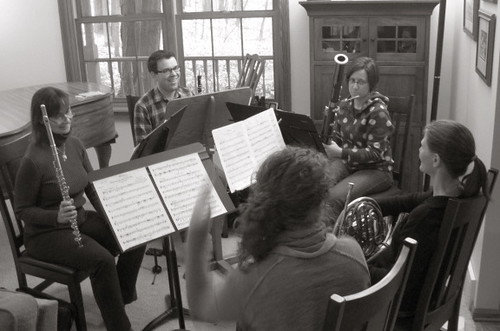 living, breathing musicians who willingly play any scribblings I place in front of them. I have the honor of learning from their experience while getting to enjoy that elusive “living sound” far more often than I would have ever imagined.
For our Spring 2016 concert, we will be presenting a program entitled “New Voices” — highlighting new composers and music written within the past 20 years. Along with a list of very talented composers’ works, one of my pieces, Three Narratives (2014) for flute, clarinet, bassoon, and piano, will be on the program.
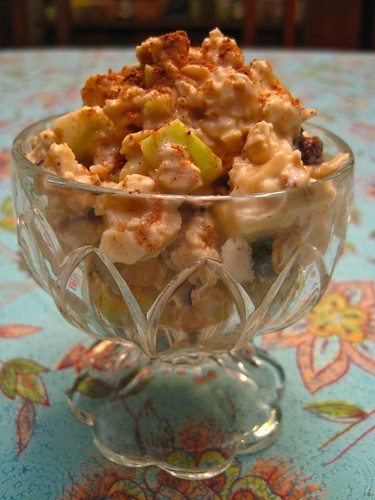
Today’s recipe, the final one from our series of “Notable Breakfasts”, is one of my personal favorite breakfasts. You can easily put it together the night before and then adorn it with whatever goodies you happen to have on-hand, depending on the season and your mood. No cooking required!
___________________________________________________________
Müesli
Serves 2
 1 cup old-fashioned oats
2 teaspoons honey
1/2 cup milk
a tiny pinch of sea salt
1/4 cup orange juice
1/4 cup raisins or dried cranberries
1/2 cup plain yogurt
1/2 medium apple, diced
1/4 cup chopped walnuts
1/2 teaspoon vanilla extract
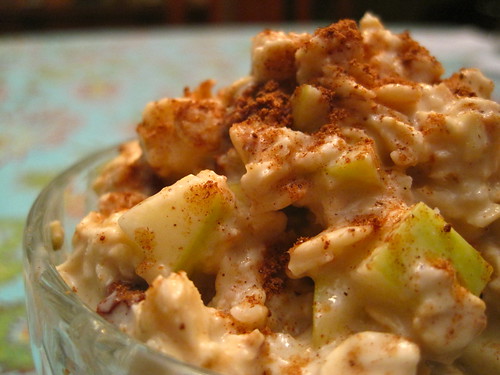
1/2 teaspoon mixed spice* or ground cinnamon
In a medium bowl, combine the oats, honey, milk and salt; stir until combined. In a small bowl, combine the orange juice and raisins. Cover both the oat mixture and the raisin mixture; refrigerate overnight.
Divide oat mixture, soaked raisins, and any remaining orange juice into two serving bowls. Divide yogurt, apple, walnuts, vanilla, and spice between the two bowls; fold the mixture together. Serve chilled.
*Jason’s Mixed Spice
Yields about 4 tablespoons
1 tablespoon ground cinnamon
1 tablespoon ground coriander
1 tablespoon ground nutmeg
1/2 tablespoon ground ginger
3/4 teaspoon ground allspice
3/4 teaspoon ground cloves
Combine the spices in a small bowl or jar and keep in an airtight container. More exciting than plain cinnamon and more complex than pumpkin spice; you’ll find lots of opportunities to use this blend.
___________________________________________________________
Looking for more recipes? Check out the other recent Woodwind Gourmet series:
Series I: Oboes, Oranges & Almonds
Woodwind Gourmet: Jenni’s Tofu Scramble

My fascination with composers’ eating habits began innocently enough in my undergraduate years… now that I’m no longer a student and can study anything I choose, I’ve decided to dust off that quest and go off in search of my favorite composers’ favorite breakfasts!
While composers throughout history could often seek out the patronage of wealthy nobility, giant churches, or prominent artistic organizations to propel their careers and their musical growth forward, composers of today face a completely different reality. In our modern era, a composer is just one voice in an endless sea of voices — all struggling to hone their skills, express their ideas, and (above all else) have their music performed. With orchestras and other large ensembles across the globe struggling to keep seats filled and finances in check, there is precious little room for new names on concert programs.
Jenni Brandon (b. 1977) knows that struggle first-hand. Through hard work, dedication, and (admittedly) a  little luck, her compositions have already been performed all over the world — invaluable exposure that has garnered commissions from a variety of ensembles and chamber groups. She’s amassed an impressive and ever-expanding catalog of unique, original pieces for various types of ensembles. One might say she deftly navigates the “sea of voices” while maintaining a voice all her own.
With evocative titles and colorful, motivic writing, she paints landscapes using the human voice, musical instruments, and harmonic textures as her paints and canvas. In the same way a writer may go people-watching, probing the expressions and mannerisms of strangers while forming characters for their next plotline; Jenni often finds inspiration by immersing herself in nature and in the practice of Yoga.
“I do love my work and I feel blessed and content to have such joy in my life: writing music is part of my fabric, and teaching yoga has become a joyful way to serve others. I believe these are part of my
path,… We might stray from our path, we might seek contentment and balance outside of us, but it is that inner voice, that True Self, that whispers to us and draws us back to where we need to be.” — Jenni Brandon
While we can’t rattle off an e-mail to Mozart to ask his advice about a particular passage or pick the brain of Beethoven by leaving a comment on his Facebook wall, today’s musicians and composers have exciting, unique opportunities to collaborate — taking new music to new audiences in new ways.
Manitou Winds is presently studying two of Jenni Brandon’s works: On Holt Avenue (2006), for solo oboe and piano; and Found Objects: On the Beach (2013), for oboe, clarinet, and bassoon. Our goal is to feature these two works on a program in 2016 along with music from other new composers written within the last 20 years.
Recently, I e-mailed Jenni to congratulate her on creating these two beautiful pieces… and, of course, to ask her about her favorite breakfast. Imagine my delight when she responded! She said she was happy to take part in our series — and especially to be our vegetarian/vegan composer.
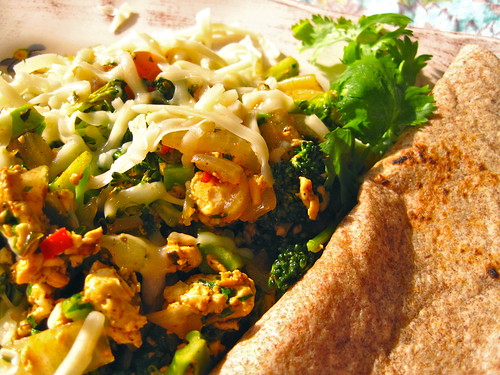
Jenni’s a big fan of getting breakfast from her juicer, but she’s also a sucker for a good sit-down breakfast like this Tofu Scramble. If you’re new to tofu scrambles, you’re sure to be hooked. They allow plenty of room for improvisation — add or take away any vegetables you’d like — and they’re easy to throw together for breakfast or even a quick dinner.
___________________________________________________________
Tofu Scramble
Serves 4
4 teaspoons olive oil, divided
1 medium onion, diced
2 cups chopped broccoli florets
 1 medium red bell pepper, diced
1 medium carrot, shredded
4 cloves garlic, minced
2-4 chili peppers, chopped* (jalapeños or a mix of varieties)
1 tablespoon chili powder
1 teaspoon ground cumin
1 teaspoon dried oregano
1/2 teaspoon ground turmeric
14 ounces extra-firm tofu, crumbled
1 tablespoon lime juice
2 tablespoons chopped fresh cilantro
Corn or Whole Wheat Flour Tortillas
Pepper Jack, Sharp Cheddar, or Vegan Cheese (optional)
Salsa (optional)
Heat two teaspoons of the oil in a large non-stick skillet over medium-high heat. Add the onion; cook until translucent and golden. Stir in the broccoli, bell pepper, and carrot; cook until crisp-tender (3-4 minutes). Transfer the vegetables to a plate; keep warm.
To the now empty skillet add remaining oil, garlic, chili peppers, chili powder, cumin, and oregano. Sauté for 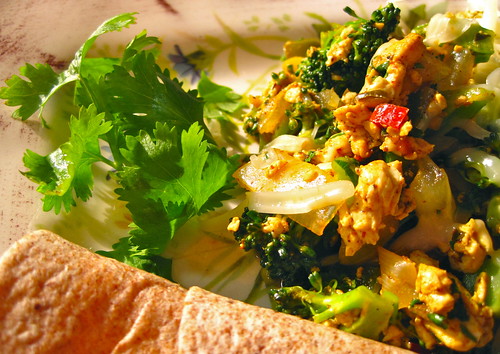 about 30 seconds to release the flavors. Stir in turmeric and crumbled tofu; cook 2-3 minutes or until tofu has dried slightly and begun to lightly brown. Return the sautéed vegetables to the skillet; stir and cook until heated through. Serve on warmed tortillas and top with cheese and salsa if desired. Leftover scramble is delicious and easily reheated.
*If you want a milder scramble, remove the seeds and membranes from the chiles. Jenni prefers it spicy, though… and so do I!
___________________________________________________________
For the perfect Jenni Brandon soundtrack to accompany your serene scramble, here’s the fourth movement, entitled “Daisies”, from On Holt Avenue:
[youtube https://www.youtube.com/watch?v=oet9HuxicfU&w=400&h=225%5D
Looking for more recipes? Check out the other recent Woodwind Gourmet series: