
One Ambivalent Shepherd

This post was written in preparation for our May 2017 concert, Music Speaks
In our 2017 spring concert,
Manitou Winds explores the meandering, mystical path connecting music and words.
Words and music have long been intertwined going back to ancient times and continuing into our modern era of singer-songwriters. But, it was the composers of the Romantic Era (1820-1900) who began to be so moved by contemporary poetry and literature that they began to explore ways to enhance words with music — adding nuances and emotions that words alone were incapable of communicating.1
Prior to the influence of Romantic idealism, words and music often joined together in a sort of marriage of convenience. Poems were often written to fit existing melodies while musical accompaniment would be matched to a poem with little more reason than a shared meter.2 Depending on the listener’s perspective, the relationship between music and poetry was seldom more than one being a colorful delivery vehicle for the other!
At the beginning of the nineteenth century, composers began to write music that spoke to their own interests and ideals rather an aristocratic patron’s wishes. No longer at home in the lavish ballrooms of the affluent, the forefront of musical development was to be found in much more informal parties held in private homes where men and women 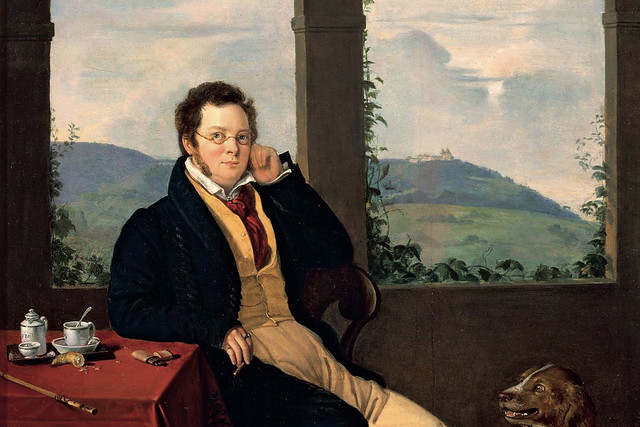 with interests in the latest poetry, literature, art, and music would gather to perform and be entertained.1 It was in this vibrant, scintillating atmosphere that the art song (i.e. lied) was created.
Perhaps the most famous Romantic to unite music and poetry in a passionate embrace was Franz Schubert (1797-1828). In his short lifespan of a mere thirty-one years, he lived the rough-and-tumble Bohemian life of a true Romantic: abandoning a career in teaching to pursue his passion — a move which made him virtually penniless, but enabled him to write more than 600 art songs (not to mention several masterpieces in other forms).
“When one has a good poem the music comes easily, melodies just flow, so that composing is a real joy.” 1
— Franz Schubert
(1797-1828)
Schubert’s approach to writing art songs had a lasting influence on the composers who would follow. Rather than merely writing music to accompany poems, he joined poetry and music in a way that sought to make them inseparable. He purposefully bent the rules of harmony and often broke with conventional ideas of form — expanding the vocabulary of music, enabling it to speak more clearly to the listener and get at the meaning of the poetry.
Within the staves of Schubert’s art songs, music forms an intimate, sympathetic relationship with the text. When the narrator of a poem feels sadness, there is a very purposeful shift in harmony to evoke that emotion. When there is a sudden burst of joy in the text, the music has often built up to that same passionate fervor even while the text was only beginning to hint at it.
Der Hirt auf dem Felsen (English: The Shepherd on the Rock), D. 965, was written in the final month of Schubert’s life and demonstrates his unique talent in marrying music and poetry. While arguably not an example of his most deeply-felt connection to a pre-existing text, Schubert was clearly showing off!3
Designed to be a showpiece for the famous operatic soprano Pauline Anna Milder-Hauptmann, he was instructed to write a work allowing her to express a wide range of feelings and emotions onstage. Perhaps because the clarinet was a fairly recent addition to the orchestra and yet another opportunity to add innovation, Schubert added a clarinet to the usual voice and piano combo.
For the text, Schubert wove together lines from three different poems written by two different poets. In effect, the song is divided into three fairly distinct segments. The first and third segments were excerpted from two poems written by Wilhelm Müller (1794-1827) — “Der Berghirt” (The Mountain Shepherd) and “Liebesgedanken” (Thoughts of Love) — while the middle section was written by K.A. Varnhagen von Ense (1785-1858), excerpted from his poem “Nächtlicher Schall”(Nocturnal Sounds).
When on the highest cliff I stand,
gaze down into the deep valley
and sing, and sing,
the echo from the ravines
floats upwards from the dark valley
far away.The further my voice travels,
the clearer it returns to me
from below, from below.
So far from me does my love dwell
that I yearn for her more ardently
over there, over there.
With deep grief I am consumed,
my joy is at an end;
all hope on earth has left me;
I am so lonely here,
I am so lonely here.So longingly sounded the song in the wood,
so longingly it sounded through the night,
drawing hearts heavenwards
with wondrous power.
Spring is coming,
Spring, my joy;
now I will make ready to go journeying.Der Hirt auf dem Felsen, D. 965
Translation by Lionel Salter
Reading the text from a purely literal stance, it seems a bit vague if not overly-dramatic. Perhaps you also sense a change in voice between the two different poets. Here, Schubert’s music masterfully fills in gaps of emotion, meaning, and time left open by the words. Through carefully-placed harmonic changes and recurring, memorable themes, Schubert unites the poetry into a single voice. Through the union of words and music, you find yourself feeling the shepherd’s longing and just as easily understanding the sudden joy and hope of springtime.
It’s a marvel that he composed a piece filled with joy and hope while suffering from the very illness that doomed him to an early death. Sadly, we don’t know whether Schubert ever heard his piece performed. He certainly couldn’t have known how enduring it would be; he died only a month after completing it, and its premiere occurred nearly two years later.

The trio of soprano, clarinet, and piano are in conversation and practically dancing throughout this song — a dazzling display of dexterity and vocal agility! A work of such range and depth is demanding for all the musicians involved. Manitou Winds is excited to present this Romantic masterpiece featuring Emily Curtin Culler, soprano; Anne Bara, clarinet; and Susan Snyder, piano.
We hope you’ll join with us in celebrating the coming of spring and the unity of words and music at our spring concert.
References
1. Wright, C. (1996) “Listening to Music”, West Publishing Company; St. Paul, MN. pp. 245-249.
2. Grout, J. & Palisca, C. (2001) “A History of Western Music”, W.W. Norton & Company; New York, NY. pp. 448-449, 544-546.
3. Howell, C. (2013) “Der Hirt auf dem Felsen”; http://www.musicweb-international.com/classrev/2007/Apr07/Hirt_430542.htm
What’s in a Title?

This post was written in preparation for our May 2017 concert, Music Speaks
In our 2017 spring concert,
Manitou Winds explores the meandering, mystical path connecting music and words.
Music and words are often united through a composer’s use of poetry or prose (i.e., lyrics), but sometimes a composer chooses to leave even more to the imagination by guiding audiences through scenes or stories using words only in a work’s title. With an evocative title and the composer’s clever use of colorful composition techniques, each audience member can journey to the destination the composer intends, and yet each can experience a different story or scene.
One such piece on our Music Speaks program is Pastoral, Op. 21 (1943) by Vincent Persichetti (1915-1987). A masterpiece in wind chamber music since its premiere by Philadelphia’s Curtis Quintet, this single-movement piece evokes for the audience bright and sunny scenes of rural life.
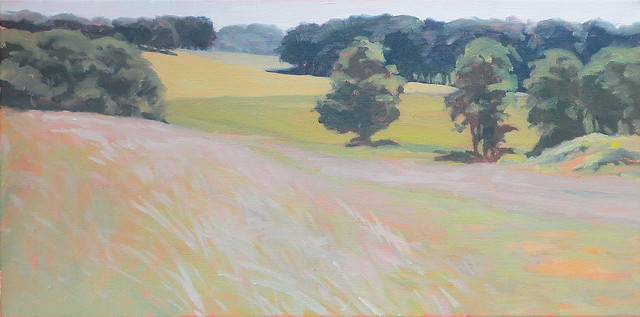
By definition, a “pastoral” is meant to be a depiction of pastureland, shepherds, farmers, beautiful idyllic countryside.1 What country? Which people? It turns out these details may be at least partly up to the audience’s imagination.
Written during his late twenties, while still a doctoral student, many scholars feel Pastoral reflects a composer who was yet on the cusp of finding his own compositional voice, possessing a technique still much influenced by Stravinsky, Bartók, Hindemith, and Copland.2 Flavored as it is with a Coplandesque folk song sensibility and angular harmonies reminiscent of early 20th century composers, the voice of Persichetti’s influences is fairly obvious; but so too is his unique character — full of surprises, twists, and turns.
“… if I knew you very well, I would rather not be talking to you in words; I would rather talk to you in a piece I write. All my relationships are more meaningful when it’s through my music.” 3
— Vincent Persichetti
(1915-1987)
Though it would be hard to prove scientifically (opinions would certainly vary from listener to listener), I believe it would be hard to listen to this piece and not picture the countryside — even if the title were kept secret from you. That, I believe, is proof that Persichetti captured a bit of the magic between music and words, making his Pastoral an endearingly popular piece for wind quintet.
As important as it is for the audience to explore the countryside using the live performance as a sort of map, the members of Manitou Winds must use the inner workings of Persichetti’s composition as a guide — shepherding all of his motifs and harmonies into a unified depiction of idyllic country scenery. To help us, we often talk about what we feel our individual parts might be contributing at any given point in the music, and also what the overall “story” of the piece might be.
While some who have written about this work hear a series of distinct scenes with contrasting characters and plot lines all their own, my own vision is far more simplistic. It’s a story of an ordinary drive along a rural highway that takes a spontaneous, child-like turn…
You’re driving along on a sunny day — maybe with a particular destination in mind, but you’re in no hurry to get there. You are blissfully unhinged from anyone’s schedule; a rarity in today’s world. Suddenly, around a bend in the road, the trees part to reveal a beautiful meadow with rolling hills, a pond in the distance with some cattails and a willow tree, maybe a few cows scattered about.
Entranced by the beauty, you find yourself pulling over to the side of the road to take it all in. On a whim, you step out of the car, walk to the edge of the fencerow, and lean cautiously onto it as you stare out across the meadow. Regardless that you’re wearing your good shoes and clearly not dressed for a hike, you suddenly find yourself going over the fence, smudging your clothes on the rough, weather-hewn boards. You notice this, but you keep going.
Birds skirt and soar overhead as you make your way across the meadow headed toward the pond. For a brief moment, you worry someone may be watching, wondering what you’re up to, but all those worries of self-consciousness dissolve as a breeze sweeps across the tall grasses, uniting them into a sea which parts and then enfolds in your wake. Weren’t there cows somewhere — OH! Yes, and here are their tell-tale leavings so suddenly and perilously in the path of your steps!
After a few spontaneous detours, you finally reach the edge of the pond  by skirting across a patch of ground far boggier than expected (your shoes have simply had it by now). From a raised part of the bank where the old willow reclines, the pond reflects an early summer sun in its late-afternoon glow, rippled and dappled across the water. Your breaths come slower now, like the sighing of those willow branches brushing delicately against an invisible breeze.
How long have you been standing here? Is it okay to leave now? A brief escape from the everyday, maybe a momentary lapse of common sense in exchange for uncommon grace. A short excursion, but a meaningful one!
You’re invited to scurry over the fence with us and come along for an escape from the everyday on a journey with music as a map and words as pictures!
The pastoral-themed landscapes in today’s article are from the studio of our 2017 collaborating artist, Margie Guyot. For more information about Margie’s home studio and gallery and to view many more examples of her work, visit www.MargieGuyot.com.
References
1. Wikipedia, The Free Encyclopedia, s.v. “Pastoral,” (accessed March 26, 2017).
2. Wikipedia, The Free Encyclopedia, s.v. “Vincent Persichetti,” (accessed February 15, 2017).
3. Duffie, B. (November 15, 1986) “Composer Vincent Persichetti: A Conversation with Bruce Duffie”; http://www.bruceduffie.com/persichetti.html
Music Speaks: The Art of Collaboration

This post was written in preparation for our May 2017 concert, Music Speaks
Manitou Winds continually finds inspiration in the stories of the composers who write the music we enjoy sharing. We also seek fresh inspiration in the vibrant arts scene in Northern Michigan — selecting a new Collaborating Artist each year.
We’re often asked what it means to “collaborate” with an artist — especially when we obviously work in two completely different mediums. My favorite answer: each collaboration means something different! No two composers speak through music in quite the same way, and no two artists infuse the canvas with the same verve and personality, and so each collaboration means a new discovery.
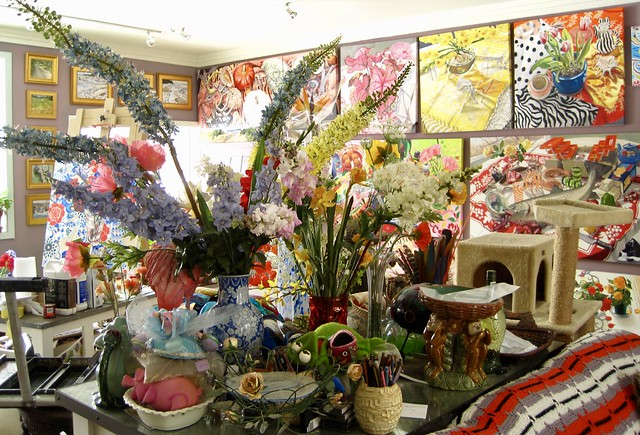
Throughout each collaboration — through conversation about our unique art forms, and putting together a joint concert and exhibit — artist and musician alike often discover new aspects of their art and take our audience along for the ride. Not knowing where exactly that ride will go is part of the fun and makes it nothing at all like an assignment… and fun is pretty well our spring 2017 artist’s specialty!
I first met Margie Guyot in an unexpected way — during a fateful Encore Winds rehearsal. When someone aims a saxophone at you, you tend to take notice! It wasn’t too long after that rehearsal when  I happened to be browsing on Facebook and read an interview where Margie casually mentioned oil painting was a hobby of hers. Later that summer, while browsing in North Seas Gallery in Charlevoix, MI, a lovely landscape painting caught my attention. I did a double-take: Margie Guyot was the artist. “She’s no ‘hobby’ artist!” I thought.
Originally from Iowa, Margie grew up in love with both art and music — a penchant for expressing herself, you might say. Her family’s basement was always loaded with art materials, and she attended weekend art classes at the Davenport Art Museum. Art was fun – until high school, at least. That’s when her art teacher found out she also played saxophone and told her she couldn’t be in band and art. And so, Margie dropped art and majored in music — out of spite.
“The power of spite can accomplish a lot — not all of it bad!” — Margie Guyot
“Spite” led Margie down the single-track road of music for a while. After receiving her bachelor’s degree with highest honors in music education, Margie made another critical decision in choosing not to teach. Instead, she took to the highway, playing saxophone in a road band touring the Midwest, dressed to the 9’s whilst living off mac and cheese.
When the “glamorous” life of a touring musician had spun its tale, Margie found her way to the Detroit area where she worked the graveyard shift at Ford Motor Company. It was 30 years of hard work and a steady paycheck, but not exactly the life she’d always dreamed of.
During these years on the line with her nose to the grindstone, art slowly began to make its way back into Margie’s life. She was inspired by Betty Edwards’ Drawing on the Right Side of the 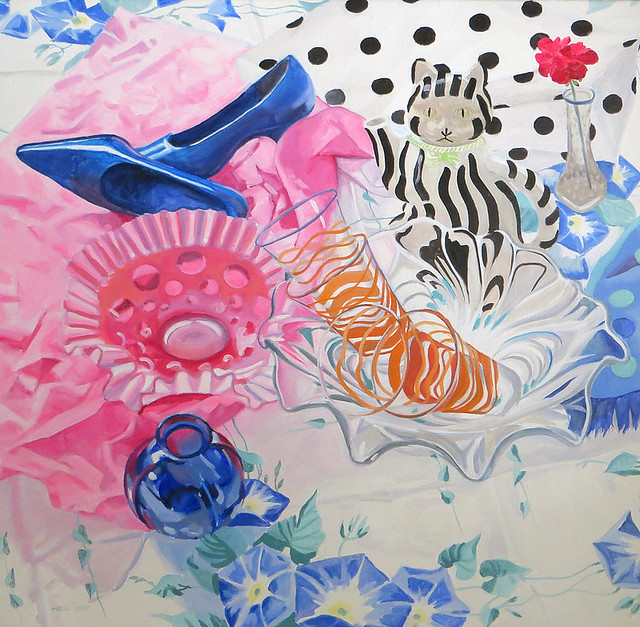 Brain — a book she says changed her life. She religiously performed every exercise in the book, gradually opening her eyes to really see.
As her renewed interest in art grew stronger, she traveled across the country (and continents) on extended vacations to study with famous mentors. In that time she studied with Robert Bateman, Clyde Aspevig, and Janet Fish — each artist contributing to her unique and colorful perspective.
Once she was finally able to retire from the assembly line, Margie moved to Northern Michigan and now paints whatever she likes every day — all from her Possum Hollow Studio in Ellsworth, MI.
Possum Hollow hosts a stunning array of Margie’s paintings. Surrounded on all four sides by their brilliance, you can see first-hand her favored painting styles vary wildly in color and content. We were able to make a trip up to Possum Hollow in early March — a chance to talk about her art and see her latest pieces.

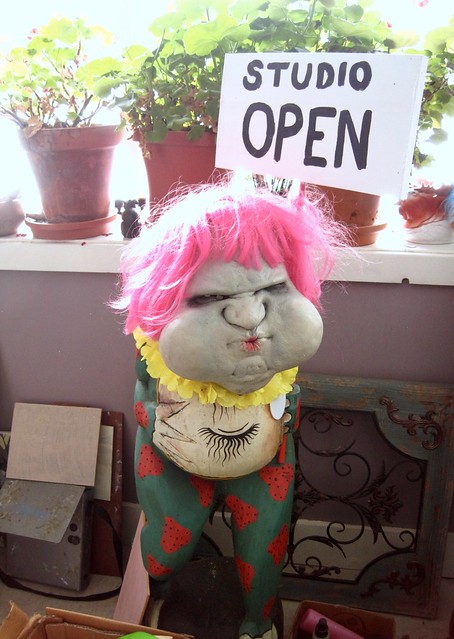
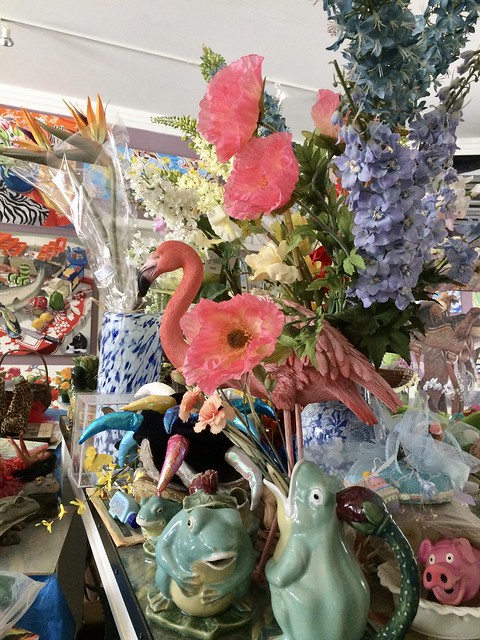

Margie always creates her landscapes en plein air, painting on location all over Northern Michigan where she finds little bits of beauty and heartfelt scenes that the more casual passersby might miss in their hurry from one place to the next.
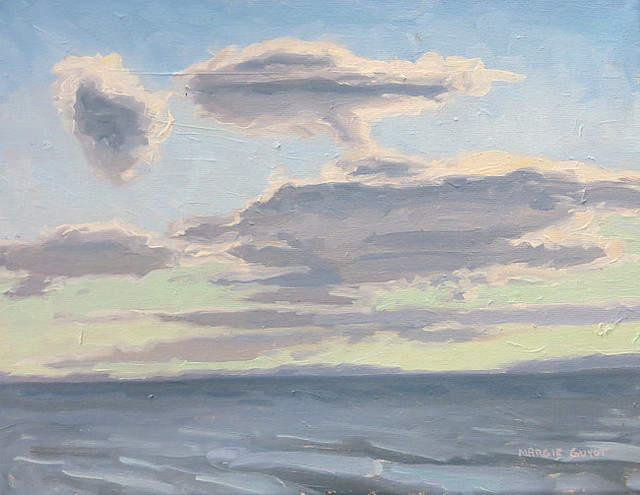
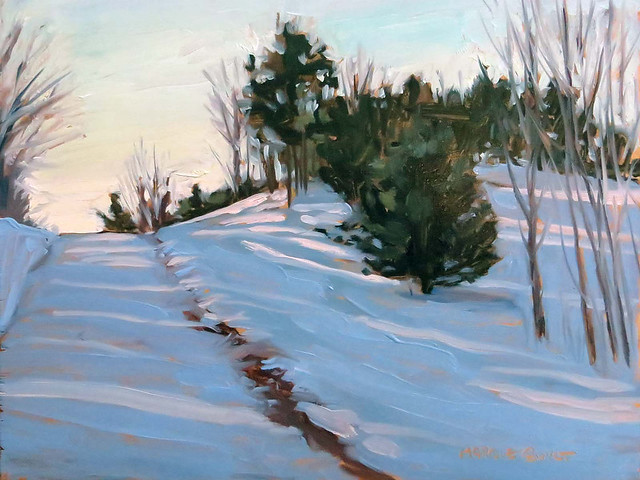

In times when she’s grown tired of more predictable landscapes and their endless variations of blues and greens, she turns to creating still life paintings where she can work in a limitless palette of saturated colors and complex patterns — juxtaposing linens, glassware, and produce with elements that might surprise (taxidermy, masks, vintage toys, and other unexpected “characters”).
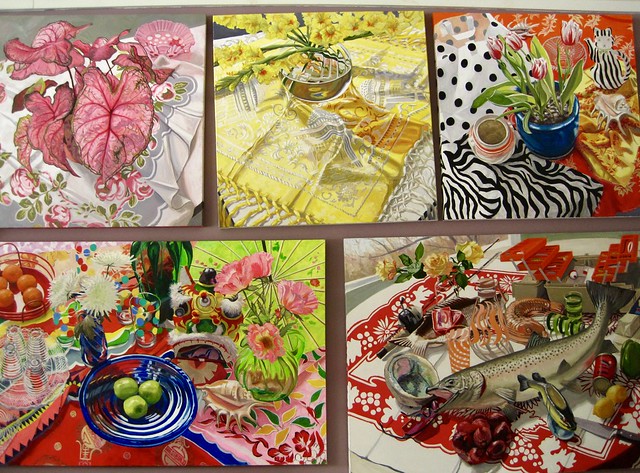
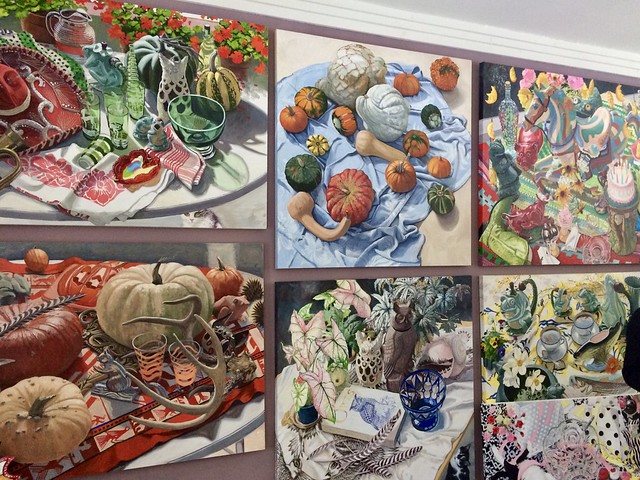
Finding visual inspiration among Margie’s work for our 2017 spring concert program, Music Speaks, was not at all difficult. Narrowing down all the choices proved to be the challenge that took much back-and-forth, however.
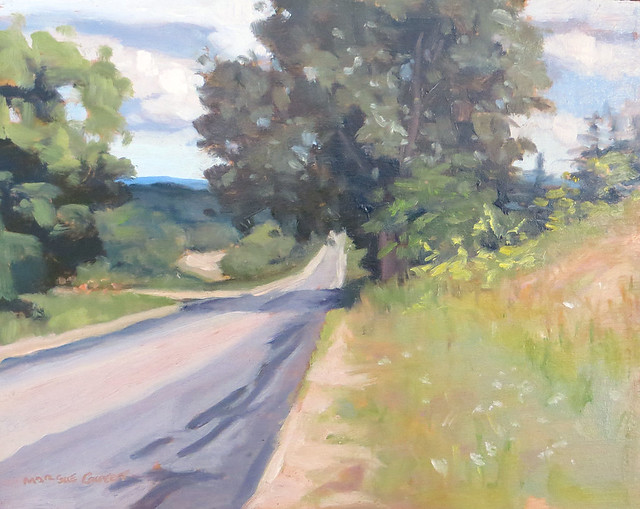
Music Speaks is a concert depicting many moods and characters, so it was hard to find a single image that would immediately, authentically stand along with the theme on a poster. Finally, after brainstorming and searching through the paintings a bit more, I realized the symbol of a road — a path connecting two places or two ideas — was a central part of our theme.
One of Margie’s recent landscapes, Rogers Road (2016), stood out immediately. The painting depicts a particular hideaway near East Jordan — a location Margie says she’s painted several times in all seasons. On a particular day in midsummer, she was inspired to paint on the roadside in the shade of a kindly tree who happened to be in the right place at the right time. The colors, the warmth of the sun, the wind in the grass, the sense of adventure of the open road… suddenly it was all making sense!
Since our visit was in early March — just as the robins had begun to make their gradual reappearance and a thin layer of snow 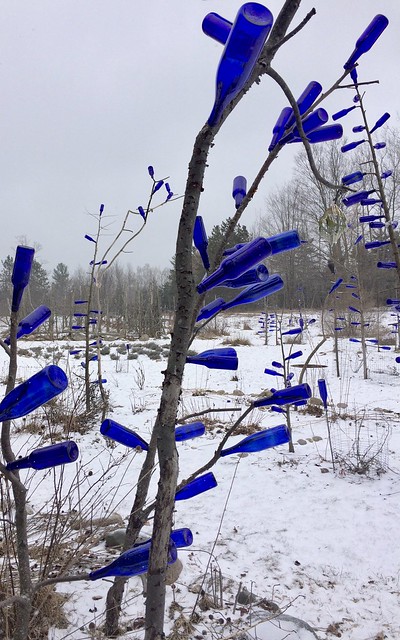 was still on the ground — we weren’t able to have a grand tour of Margie’s extensive Possum Hollow Gardens. We’re certainly looking forward to a tour later this summer to see all the potential art in full bloom.
As part of our spring collaboration, you’ll get a grand sampling of Margie’s work in a special exhibit at the concert venue. Stay tuned for more details!
Manitou Winds in the media!
2016 was a dynamic year for Manitou Winds — many opportunities to get out into the community and share the intimate quality of chamber music while also spreading imagination, creativity, and inspiration through visual art from our collaborating artist, Ellie Harold.
In April, Jason and Ellie were invited to go on air with the Christal Frost show on WTCM 580 AM in Traverse City’s Radio Center to discuss our spring concert. Jason had never been on the radio before! Microphones and cables everywhere… it was quite an experience.
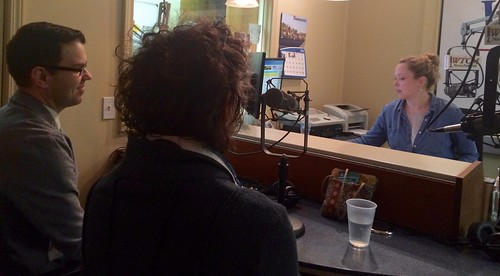

In November, Ellie and Jason were interviewed by Allison Batdorff of the Traverse City Record-Eagle. We were gearing up for 2016’s Winter Songs & Carols concert, and also reflecting on the year’s collaboration with Ellie. You can read the full article HERE.
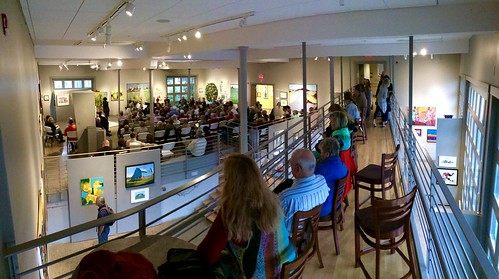
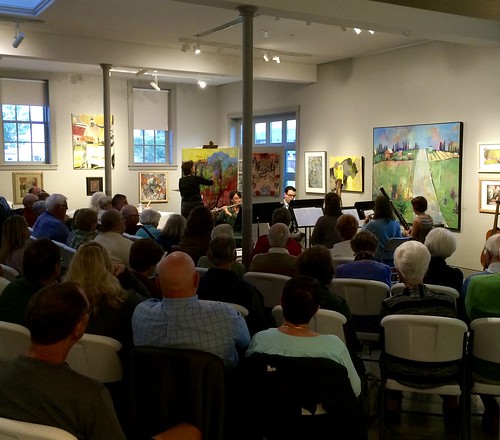
In December, Jason and Ellie were interviewed by MINews 26’s Marlaina Scarbrough, spreading the word about what makes chamber music so unique and describing our efforts to bridge the gap between visual and performing arts.
[youtube https://www.youtube.com/watch?v=pmPjZb-8kz4&w=560&h=315%5D
We’re certainly excited about 2017 — our new collaborating artist (Margie Guyot) plus plenty of upcoming concerts. We hope you’ll be able to join us in May for “Music Speaks…”. Stay tuned for more details!
St. Basil’s Hymn

In our annual winter concert, Manitou Winds presents
a program of music, poetry, and prose inspiring you to embrace winter.
Have you ever heard a tune that just kinda grabbed you by surprise and then stuck around? We have a lot of terms for this potentially irksome phenomenon (ever heard of an earworm?), but sometimes finding out a little bit more about the tune that caught your  attention can provide a sense of satisfaction if not relief. But what happens if it just leads to more questions?
Jason found himself in just that spot when he decided to include St. Basil’s Hymn on this year’s Winter Songs & Carols program. “I’m a little embarrassed to admit that I first heard the tune in a context pretty far-removed from what might be considered the original,” says Jason. “I heard it on George Winston’s excellent album (December from 1982) in a track he titled Night, Part III: Minstrels. I was immediately drawn in by the tune because it called to mind, for me, images of quiet, snowy winter. I had no idea about its origins, but I often listened to it well beyond the Christmas season.”
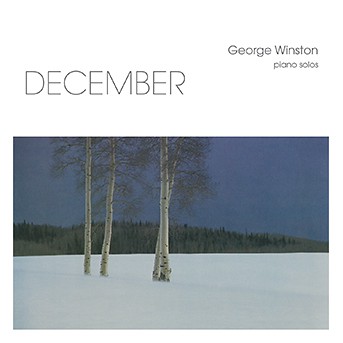 George Winston’s December liner notes say Minstrels was inspired by St. Basil’s Hymn, a traditional Greek children’s New Year’s carol, based upon a rendition by Malcolm Dalglish from his album Thunderhead from 1982.
Dalglish, a prolific dulcimerist and composer, later released the tune in a work for dulcimer and Children’s Choir (Kalanta of the New Year). But, in researching, Jason soon found that the tune can pop up in many different contexts sometimes even when the performer isn’t intending to evoke New Year or even Greek folk music.
“From this, I can only gather that the tune inspires a certain mood that makes it more or less independent from the lyrics,” says Jason. “Tunes and lyrics — especially in folk music — have a way of joining up and then parting ways. Many of our most beloved Christmas carols began as poems that someone much later decided to add to a pre-existing and unrelated tune, and we often don’t know who wrote either component.”
St. Basil’s Hymn is one of many traditional carols (often referred to as calanda) from Greece that are still sung by children on St. Basil’s feast day (which is also New Year’s Day). In the 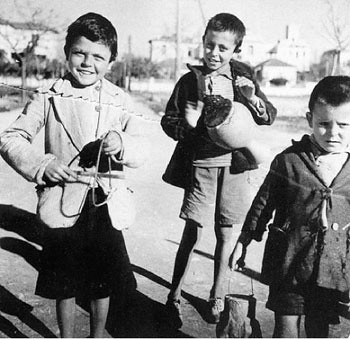 tradition still practiced to some extent in modern times, Greek children roam the neighborhoods from house-to-house on St. Basil’s Day, playing instruments and singing songs, bidding New Year’s tidings to everyone. Over the years, the young carolers have gone from receiving gifts of sweets and pastries to often walking away with cold-hard cash. “These are the ‘minstrels’ George Winston was referring to!” says Jason.
Uncovering the tradition behind the carol was interesting enough, but what about those lyrics? And who was St. Basil? The questions were only growing…
Saint Basil of Caesarea (c. 329-379) was an influential figure in the early Christian church whose theological writings and prayers are still in use. Though he lived in fourth century, he is still  very much a sacred figure especially in the Greek Eastern Orthodox Church. In Greek traditions, honoring St. Basil has gradually evolved his presence into something like our western Santa Claus wherein he is said to bring gifts to children on January 1st. Greek families also bake (or buy!) a special bread to commemorate St. Basil in a tradition similar to western traditions surrounding the feast of Epiphany.
The happy minstrel children, wandering the streets of a small village playing instruments and singing happy songs of St. Basil and the New Year. But what are the lyrics to St. Basil’s Hymn (Archiminia ki Archihronia)? Translated directly from Greek, depending on which version is being sung, they reveal a pretty mysterious thing: two songs in one!
It’s the beginning of the month, beginning of the year
High incense tree
Beginning of my good year
Church with the Holy SeatIt’s the beginning of our Christ
Saint and spiritual
He got out to walk on earth
And to welcome usSt. Basil is coming from Caesaria
And doesn’t want to deal with us
May you long live, my lady
He holds an icon and a piece of paper
With the picture of Christ our Savior
A piece of paper and a quill
Please look at me, the young man
Historians aren’t certain, but it’s assumed these lyrics come from 17th century Greece. As we’ve highlighted to demonstrate above, random lines from the poem seem to come from nowhere suggesting a completely different story, one traditionally believed to be a love story between a peasant man and a noble woman who were separated by social class.
As early as the medieval period in Europe secular composers created works by borrowing plainchant tunes from the church and then layering new vocal lines above the Latin chant tune and text — literally two or more songs being performed at once, the lyrics often having nothing to do with one another, contextually. “It may be a crude, lyrics-only, sort of continuation of that medieval form, or it may simply be some form of misprint in the written record that just took hold in tradition,” Jason muses. “I do find it funny that the tune and lyrics are still a large part of the celebration of St. Basil even though these non-sequitur lines are embedded in the poetry.”
“The more I thought about the mysterious lyrics and the unknown love story, the more I found the tune intriguing, too.  I decided I would write a version for Manitou Winds that extracts a bit of that mystery and gives voice to this unknown poet whose lines have wandered into the wrong song at the wrong time. In my arrangement [for flute, clarinet, horn, bassoon, and harp], I give space for the original tune, but then in the middle of the piece the horn and bassoon bring a passionate countermelody over the top of the tune. In our ears — at least for a few moments — we hear more about this painful story of unrequited love and the poet’s voice soars over the tale about St. Basil. Then, like mists of time rolling in to forever obscure the poet and his story, the melody disappears back into the harmony and lines of the traditional hymn tune.”
CLICK HERE to hear our performance of Jason’s arrangement of St. Basil’s Hymn on our Listen Now page!
Winter Songs & Carols: Our Guest Vocalists

In our annual winter concert, Manitou Winds presents
a program of music, poetry, and prose inspiring you to embrace winter.
For this year’s Winter Songs & Carols performances, we’re delighted to be working with two talented vocalists who will grace the stage with their glittering interpretation of songs arranged especially for this year’s performances: Christy Burich and Emily Curtin Culler!
Christy Burich
soprano

Christy moved to Traverse City only two years ago from Chicago, IL, where she’d been working as a Music Together center director for nearly 15 years sharing the joys of making music with young children and their families. Prior to that, she lived in Los Angeles for 10 years pursuing work in TV and film having received her Bachelor of Fine Arts in Theatre Performance from the University of Michigan in Ann Arbor.
It was while living in California that Christy decided to pursue working with children and earned her Master of Arts in Marriage, Family Therapy, and Child Counseling. Still thoroughly devoted to her work with children, she currently she teaches Music Together classes at the Elevated Arts studio in Traverse City and works as a teacher assistant at The Children’s House. Christy is also a children’s birthday party entertainer and the self-producer of two children’s holiday CDs.
Marrying her delectably warm voice with her unmistakable stage presence, Christy recently charmed throngs of children and grown-ups alike when she landed the starring role in the Old Town Playhouse’s production of Mary Poppins – The Broadway Musical.
[youtube https://www.youtube.com/watch?v=ycvhKRiwMQs?t=6m5s&w=400&h=225%5D
You’ll also have a chance to see Christy onstage, January 2017, in the Old Town Playhouse production of Stephen Sondheim’s Company which, will be under the musical direction of none other than Manitou Winds’ own Sam Clark!
Emily Curtin Culler
soprano

Emily is an active soloist, chorister, and chamber musician who recently moved to Michigan from Boston. As a soprano Choral Scholar with Boston University’s Marsh Chapel Choir, she performed weekly services for audiences throughout New England and around the globe via WBUR.
She is also an original core member of the Lorelei Ensemble, a nine-voiced women’s chamber group dedicated to expanding the repertoire for women’s voices. The ensemble specializes in performing lesser-known early music while also collaborating with living composers to produce innovative programming that speaks to a wide audience. (Hear recordings of Emily singing with Lorelei HERE!)
Emily earned her Master of Science in Arts Administration with a Certificate in Fund Raising Management and Master of Music in Vocal Performance degrees from Boston University, while receiving her Bachelor of Music in Vocal Performance from Samford University. She also completed a special course of study in vocal performance at the Guildhall School of Music and Drama in London, England.
In addition to being an in-demand performer, Emily is a non-profit and arts management professional. Presently, she is Director of Development at Interlochen Public Radio, insuring quality programming for listeners all across Northern Michigan (and beyond!).
We were delighted to have both Christy and Emily out to Leelanau County, recently, for a Manitou Winds rehearsal. Naturally, rehearsal was followed by a celebratory dinner prepared by our own Woodwind Gourmet. Jason had asked both our soloists for their favorite winter dishes and then served up a meal featuring a few of their favorites. It was a great time to celebrate our collaboration and to get to know one another a little better. Here are two of the recipes for you to try out this winter!
___________________________________________________________
Tuscan Bean Soup
Serves 8
This is a wintertime favorite of Emily’s — a savory, heart-warming bowl of comfort. Jason’s version adds smoky bacon and a healthy helping of hearty greens to the mix.
 1 pound dried cannellini beans
6 ounces applewood smoked bacon, chopped into 1/2-inch pieces
1 large onion, chopped
2 medium carrots, cut into bite-sized pieces
2 large celery ribs, cut into bite-sized pieces
8 cloves garlic, minced
4 cups low-sodium chicken broth
3 cups water
2 teaspoons dried summer savory
2 bay leaves
1 bunch collard greens, stemmed and chopped (or 10oz frozen)
1 14.5oz can whole tomatoes, crushed
1 sprig fresh rosemary
Soak beans at room temperature in 4 quarts water seasoned with 3 tablespoons sea salt for 8 hours or up to 24 hours; drain and rinse well. Alternately, you can use the “quick soak method”: in a Dutch oven cover the beans with water, add 3 tablespoons sea salt, bring to a boil, cover and boil for 2 minutes, remove from heat, let soak 1 hour. Drain and rinse well.
Preheat oven to 250-degrees. Sauté chopped bacon in Dutch oven over medium heat, stirring occasionally, until fat has rendered and bacon is lightly browned. Add onion, carrots, and celery and cook, stirring occasionally, until vegetables are softened and lightly browned (10-15 minutes). Stir in garlic and cook until fragrant, about 1 minute. Stir in broth, water,  savory, bay leaves, and soaked beans. Increase heat to high and bring to simmer. Cover pot, transfer to preheated oven, and cook until beans are mostly tender (45 minutes).
Remove pot for oven and stir in greens, tomatoes, and rosemary. Return pot to oven and continue cooking until beans and greens are fully tender (40 minutes to an hour).
Discard bay leaves and rosemary, season with additional salt and pepper. Serve with warm, crusty bread and lots of friends!
___________________________________________________________
Irish Cream Truffles
Yields app. 30 truffles
Rich and sweet, these are one of Christy’s favorite ways to top off a wintertime celebration. With Irish Cream and dark chocolate, you’ll find it’s really hard to eat just one!
 8 ounces bittersweet chocolate chips
1⁄4 cup unsalted butter
1⁄2 cup heavy cream
1⁄3 cup Bailey’s Irish Cream liqueur
Cocoa powder for coating
Place the chocolate and butter in a double-broiler over medium-low heat or melt gently in the microwave; stirring frequently just until melted and uniform. Remove from heat; stir in heavy whipping cream and Bailey’s until fully incorporated. Refrigerate uncovered for at least 2 hours or until the mixture has hardened enough to handle.
Using a teaspoon or a melon baller, scoop the mixture into portions and roll into 1-inch balls using your fingertips. (This works best if you chill your hands in ice water before starting!) Place the portions on parchment. Once all have been shaped, roll the truffles in a shallow dish with cocoa powder to coat. Place on a serving platter or in a covered dish and refrigerate until ready to serve.
A Manitou Christmas Medley

In our annual winter concert, Manitou Winds presents
a program of music, poetry, and prose inspiring you to embrace winter.

As creative director of Manitou Winds, I spend a lot of time searching through titles and listening to music, curating the individual pieces that I plan to eventually morph into future programs for our ensemble. Putting a program together can be challenging. Often the toughest  part is deciding how it all begins! It’s no secret that every concert needs an opener that is not only an attention-grabber, but also maybe a bit of foreshadowing to what the audience has to look forward to on the rest of the program.
For our annual Winter Songs & Carols concert, we enjoy presenting a program that encompasses all of winter — not just the holidays contained in December. So, finding an existing opening number that would encapsulate frost, warmth, holidays, feasts, and introspection all within one score was a tall order. It’s no wonder that early in January of 2016 I began scoring “A Manitou Christmas Medley” — a medley designed especially for Manitou Winds’ unique musicians.
 The medley comprises eight of my favorite Christmas tunes in a variety of surprising twists and turns of style, tempo, and orchestration. In fact, one of the more unique aspects of this piece is that you’ll get to hear almost every combination of instruments Manitou Winds can offer: five musicians, eight different instruments!
Before I even imagined I could be a part of a group like Manitou Winds, I would often sit at the piano and play through some of my favorite tunes and imagine lines that went above and beyond my own pianistic abilities — colors and characters that I knew only an ensemble could fully enliven.
It was in the spirit of those hopeful daydreams that I chose to begin the medley with a free, rubato-laden piano solo 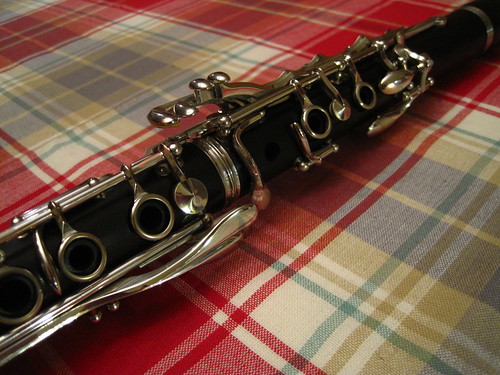 of one of Alfred Burt’s most famous carols: Some Children See Him. In the midst of the piano’s rambling, a clarinet suddenly enters to lead the ensemble in adding striking colors to the evocative harmonies of Burt’s carol. Then, we’re off to the races as the tune shifts to a driving, syncopated jazz feel.
Next, the tempo quickens and we’re suddenly playing God Rest Ye Merry Gentlemen, a 16th century British carol, in a driving, pulsating style inspired by Karl Jenkins’ Palladio. The ensemble continues on a motif from the carol while I get up from the piano bench and make my way over to the harp.
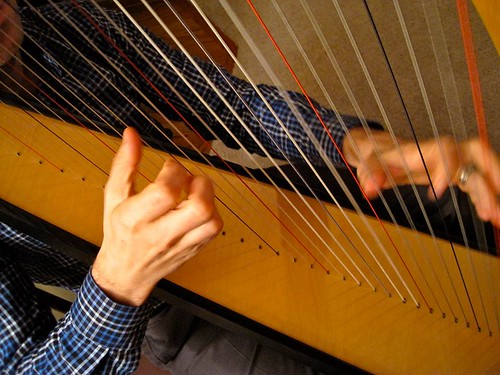

As the harmonies resolve into a dramatic climax, the harp enters with a glissando and suddenly we’re at an Irish seisiún with a foot-tapping, meter-jumping rendition of The Holly and the Ivy, a 19th century British carol. The flute takes the lead as clarinet, horn, and bassoon intertwine (as the ivy!). The harp then takes a solo turn on the tune while Laura discreetly puts down her horn and grabs her guitar.
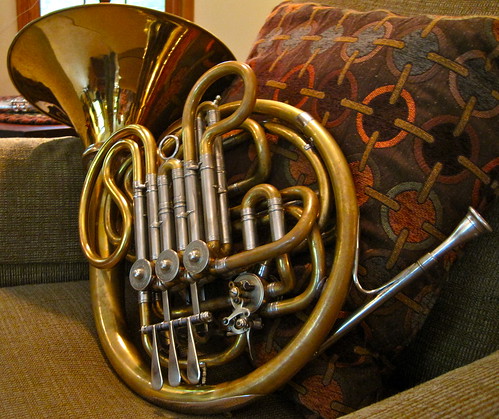

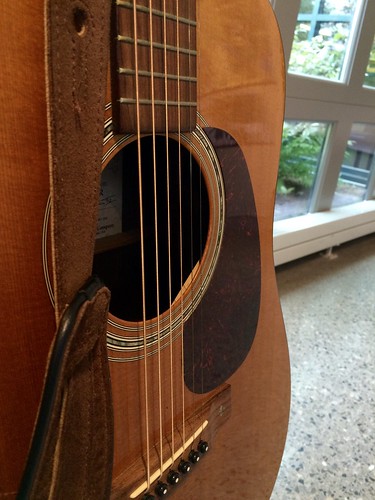
Seamlessly, the bassoon enters with a lyrical, ballet-inspired verse of Bring A Torch, Jeanette, Isabella — a carol from 16th Century France — joined by the clarinet, flute, and harp. The guitar sneaks in at the end of the verse to lead us briefly into Cradle Song — a Christmas tune I composed and hope to explore more in future pieces.
With the guitar taking over for the harp, I head over to the oboe while the key shifts to minor and there’s a guitar-flute  duet on Coventry Carol — a dark and disturbing carol from 16th century Britain.
As the clarinet and bassoon join in, we’re suddenly whisked from the mournful slaughter of the innocents with Laura’s guitar strumming a fiery Flamenco rhythm as we flagrantly juxtapose an 18th century French carol (Pat-a-pan) within the trappings of Andalusian folk music (and maybe a wee bit of Romani influence too!). It’s like a wild sing-a-long around a bonfire — you don’t argue about whether it makes any sense!
As the flames of the flamenco grow higher and 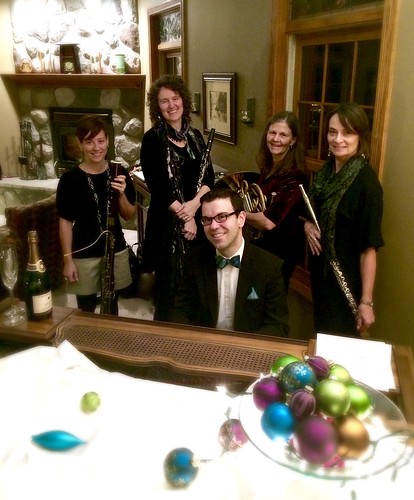 higher, we’re suddenly swept up into a very syncopated spin of the ancient Ukrainian Carol of the Bells and with a sizzling stinger of an ending, we conclude a medley that reaches across continents, centuries, and even moods!
I’m very grateful to the musicians of Manitou Winds for agreeing to embark on such a strange musical journey with me. I hope you’ll join us for the premiere of this unique medley during our Winter Songs & Carols performances.
Winter Songs & Carols: The Art of Collaboration
 In our annual winter concert, Manitou Winds presents a program of music, poetry, and prose inspiring you to embrace winter. But what does it mean to embrace a season known for darkness and cold? When confronted with the dazzling merriment expected of us for the holidays, what could we learn from a season of quiet and introspection?
During winter, a season that receives more than its fair share of bad press, we’re more often tempted to find ways of distracting ourselves from the season’s sometimes harsh realities. We huddle indoors like hermits, deck our halls with boughs of holly, or fly the coop for an extended stay someplace warmer and more life-affirming.
For our 2016 collaborating artist, Ellie Harold, winter is often a season of inner discovery. With the weather outside inhospitable for her paints and canvas, daily inspiration from picture windows becomes limited and quickly exhausted. Where else might an artist turn but inward?
Last winter, desperate for a subject to  paint, Ellie found inspiration in a most unlikely place! “A brief scrounge through my recycling bin yielded a [mostly] rinsed out ketchup container and lid. I set up a small table and started arranging Still Life With Dead Ketchup Bottle.”
“As I began to paint I was reminded how I love looking at light shining on and through a transparent object,” says Ellie. “I love how painting asks that I look more and more closely at the thing in front of me. I love how, if I look carefully and paint well enough, I actually begin to see what’s there, to feel its existence as a Presence in the world. It doesn’t matter if the thing before me is a crunched up plastic bottle with remnants of ketchup clinging to its innards – the point of the exercise is not to make a pretty picture. Rather it is to look – using paint as a medium – until I see.”
Here in Northern Michigan with many of our  favorite hang-outs closing up for the winter and some of our friends and neighbors departing for warmer climes, perhaps it’s an exercise that would benefit all of us: to look at the starkness of winter and allow the innermost elemental beauty of the season to emerge. Those of us who are artists can then take those discoveries with us to our respective “canvas” and kindle in others a passion for this season of cold and darkness.
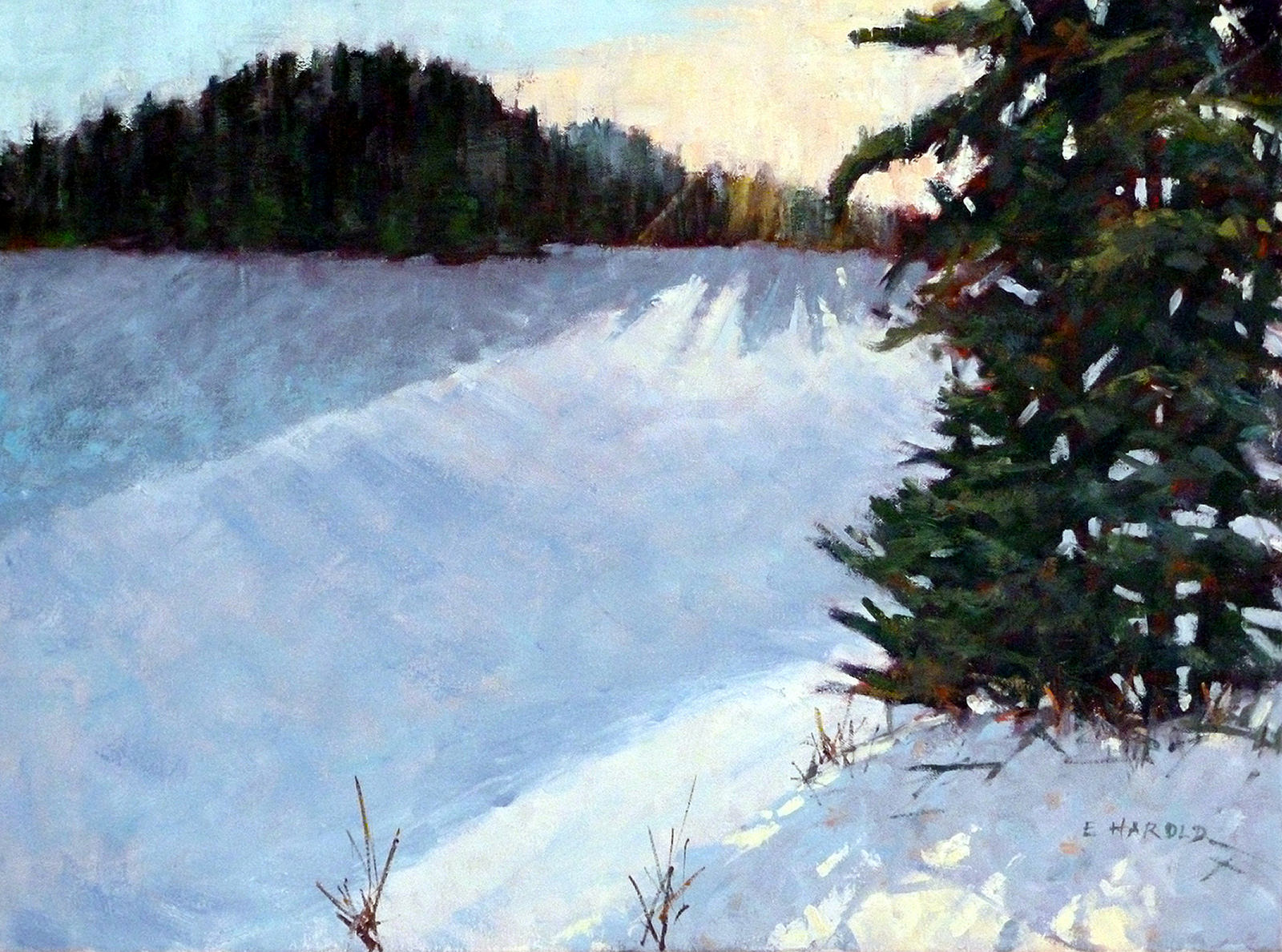
For our Winter Songs & Carols performances, this December, Ellie has graciously loaned us two of her paintings for promotion and inspiration. For the performance in Traverse City, we have SnowLight — a beautiful abstract evoking both warmth and chill, abundance and scarcity, conversation and silent wonder.

Ellie says it was during a recent winter here in Northern Michigan that her painting style underwent a significant change, leading to a series of abstract paintings. “For most of my painting life I’d been a representational artist. I painted from life or photographic references or not at all. But when the weather turned, I found myself bored with painting from photographs and insufficiently motivated to brave the Michigan cold,” she recalls. “Fortunately, the brush in my hand found its way to the palette and then to a large canvas. The result? A whole new sort of painting, one for which I have yet to develop a descriptive language. In fact, the new work seems to be its own language. It speaks to me while I’m working and fulfills a deep need to reveal my Inner Landscape.”
The painting selected for our Glen Arbor performance, Winter Sunset, explores the more literal and external landscape but its juxtaposition of light and darkness still invites us to explore a deeper landscape within. In my own musings about our winters here in Leelanau County, I marvel at how the slightest change in winter sunlight can turn an entire landscape’s mood on its head — sometimes my own mood too! There’s definitely a special magic in this season!

“Longtime residents of this area are amused at how snow continues to delight me,” says Ellie. “I tell them it’s a visual thing. I see in this winterscape fascinating shapes, colors, and contrasts — for this landscape artist that’s the whole hokey pokey. It pretty much makes up for the cold temps, howling winds, icy roads and endless layers of clothing.”
You’re invited to embark on an exploration of your inner landscape with music, poetry, prose, and a special exhibition of Ellie’s works. Our final collaboration for 2016 is an excellent opportunity to meet Ellie and see more of her work in person. Come surround yourself with winter inspiration!
For more information about Ellie’s home studio and gallery and to view many more examples of her work, visit www.EllieHarold.com.
Three Fiddle Tunes

This post was written in preparation for our September 2016 summer program.
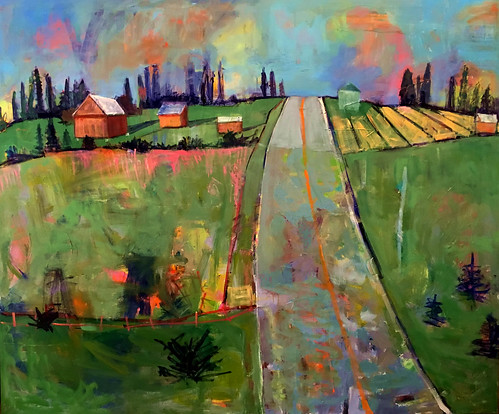
“The Secret Life of Barns (Cedar)” by Ellie Harold, 2016 Collaborating Artist
For our Summer Fantasies concert, we invite you to join us in a colorful journey for the imagination as we visit the themes of summertime and all of its fantastical elements. In this series of brief articles, you can learn more about the pieces on the program; the composers who penned them and the events that inspired them.
The second premiere on our program, this September, is a new suite based on fiddle tunes from the isle of Cape Breton arranged by Jason McKinney. “I have a list of places I’d like to visit someday and Cape Breton, Nova Scotia, is near the top of that list,” he says. “Since our concert’s theme is about fantasies, I thought it would be fun to create a musical journey to a place I long to visit someday. Plus, it was an excuse to learn more about Scottish music!”
A Suite of Cape Breton Tunes
— Jason McKinney (b. 1979)
The suite is arranged for flute, clarinet, and lever harp (i.e., Celtic harp), and contains three distinct movements. “I wanted each movement to capture a different mood or scene you might expect to find during a céilidh (pronounced KAY’-lee) — the Scottish-Gaelic word for a party where there will be singing, dancing, and storytelling,” Jason explains.
I. Natalie Fraser is based on a hornpipe tune written by legendary pianist Joey Beaton of Mabou. Beaton happens to come from a very long line of famous Cape Breton composers and musicians. The hornpipe is a dance many northern European cultures share — each with their own version and traditions. In Cape Breton, the hornpipe is usually a lively dance in 4/4 time (though it can be danced slowly when the occasion calls for it) with a distinctly contrasting A & B sections.
Jason explored what he could from the  internet about Beaton’s tell-tale style of piano accompaniment. “In traditional Cape Breton music (which is seldom written down by the way), the piano accompaniment usually provides a bass line and rhythmic foundation for the undulating fiddle while ‘filling in’ chords and harmony. Since fiddling is nearly impossible on wind instruments, I basically split the musical roles between all three members of the trio,” Jason explains. “The harp part provides the bass line and the basic harmony, but it also grabs bits and pieces of the melody, allowing the flute and clarinet a little liberty to breathe and also embellish.”
Watching the dancers of the hornpipe swirling and bouncing like planets shifting in and out of their orbits is a bit mesmerizing (watch a hornpipe here). While there won’t be any dancers at our concert, it’s not hard to imagine them as the flute, clarinet, and harp weave in and out of the texture of the trio seamlessly.
II. The Rosebud of Allenvale is based on a relatively simple tune by the famous Scottish fiddler, dancer, and 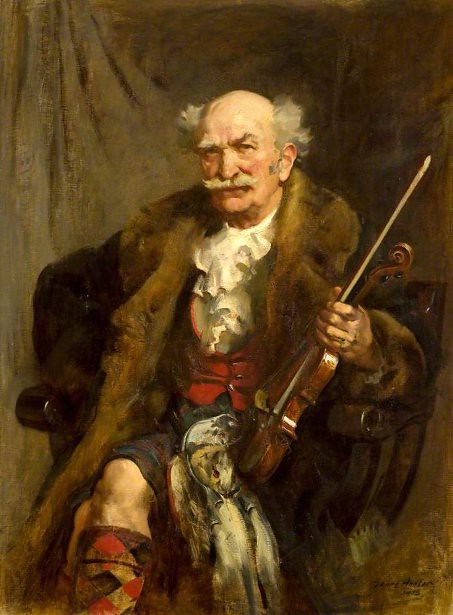 prolific composer J.S. Skinner (1843-1927). Many Scottish emigrants to Nova Scotia arrived as a result of being thrown off their lands during the Highland Clearances. These displaced Scots made their way to North America and beyond, carrying their culture with them. A thoroughly Scottish citizen, Skinner’s music influenced the Scottish community in Nova Scotia because of his international notoriety and his advancement of Scottish music and dance.
“Since the traditional céilidh would contain at least a little storytelling, I thought this charming lyrical melody would be a great segue from the dancing,” Jason explains. “I imagined everyone making their way to their seats or gathering around as a single vocalist began singing a lyrical ode to a lost or current love.”
In this movement, the melody is carried mostly by the clarinet with the flute taking on the role of an accompanying violin while the harp provides graceful, arpeggiating accompaniment. “I think what drew me to this melody initially was that it was calming and graceful without the expected hint of tragedy that almost always finds its way into Celtic music,” Jason explains. “Reading the title then hearing the melody, you get the sensation that the fiddler is filled with pride or love rather than mourning.”
But, alas, after digging deeper there remains that little hint of tragedy. Skinner published this tune around 1922 and dedicated it to his cousin Jessie who was married to the gardener at Allenvale Cemetery in Aberdeen, Scotland. In his original inscription, Skinner wrote, “The Rosebud is in full bloom and will be played when you and I are asleep.” J.S. Skinner died five years later and was buried in the Allenvale Cemetery.
III. The Night the Goats Came Home  (sometimes known as “The Night We Had the Goats”) is a traditional Cape Breton reel tune. Here’s the moment in the céilidh where everyone has likely had one too many and the party’s getting decidedly rowdy! The fiddler takes the stage to get the crowd on its feet. “I’ll be honest, I don’t know how this tune got its name,” says Jason. “It’s so energetic, though, one just understands that it was an awesome thing when the goats showed up (perhaps for one night only)!”
In Scottish folk music, a reel is one of four traditional dances, but it is also a loose musical form (usually used to accompany the dance of the same name). Similar to the hornpipe, a reel has contrasting A & B sections that are repeated (sometimes growing faster and faster). In contrast, the tempo of a reel is often much faster than the hornpipe and/or its melody is more heavily embellished (i.e., fiddled).
“I’m honored to have Sam and Anne perform this suite with me. Working on the intricacies of the music and working through my own learning process on the harp was a joy thanks to their dedication and energy to their individual parts.”
— Jason McKinney
“This is the toughest movement of the suite,” Jason confesses. “Between the tricky embellishments written in the flute and clarinet parts and the muffling technique required in the harp part to create a pianistic effect between each chord, there is a good bit of challenge to getting this reel in motion. While not exactly like a fiddler’s bow strokes (watch a fiddler play this tune here), I think the energy and effect are similar.”
We look forward to sharing this one-of-a-kind foray into Scottish folk music with you.
Summer Waltzes Out

This post was written in preparation for our September 2016 summer program.
“The Secret Life of Barns (Cedar)” by Ellie Harold, 2016 Collaborating Artist
For our Summer Fantasies concert, we invite you to join us in a colorful journey for the imagination as we visit the themes of summertime and all of its fantastical elements. In this series of brief articles, you can learn more about the pieces on the program; the composers who penned them and the events that inspired them.
We’re so excited to be premiering another new work written by a member of our group: Laura Hood. In May, we unveiled First Flight — a quartet for flute, clarinet, harp, and guitar. Now, just in time for our Summer Fantasies concert, Laura has finished a new piece for the same quartet.
Summer Waltz
— Laura Hood (b. 1961)
The theme for Summer Waltz was composed about six years ago when Laura was part of a much different small ensemble — flute, violin, hammer dulcimer, and guitar. I like to think the theme needed some time to steep before Laura fully committed it to paper!
When a composer is deciding which instruments will be used in a composition, it is not unlike a painter gathering the pigments and paints just before heading to the canvas. Sometimes a composer simply writes using the instruments available, but other times they are able to hand select the timbres and colors they prefer.
“I really love the arrangement for Manitou Winds,” Laura says. “The combination of harp and guitar is perfect especially when Jason is playing in the lower registers — the harp has a depth that is missing even in the lowest strings of the guitar. The rich, woody sound of the clarinet is also wonderful in this piece, and Sam’s rich tone on the flute completes the ensemble.”
Having selected the instruments, the next task is deciding where the piece will go — what story it will tell, or what picture it will paint…
“As I was writing this short waltz, I was picturing a hot and humid summer night, with a warm wind blowing and the cicadas and crickets chirping,” Laura 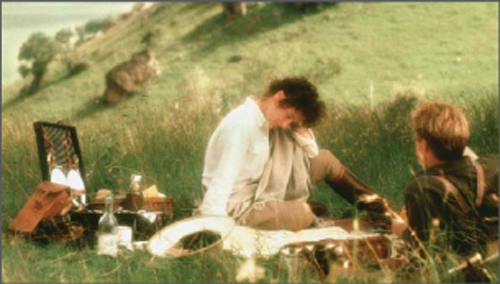 recalls. “A couple in love is dancing slowly on their big front porch. I picture a setting like that in my favorite movie, Out of Africa, when Robert Redford and Meryl Streep are together on her farm.”
During rehearsals, we’ve all had fun describing what Laura’s new waltz evokes in our minds. Magically, we all seem to see summer scenes, albeit different ones. Laura’s is cinematically inspired — a hopeless romance wrapped in the warm embrace of an impossible summer. My own is more mundane, but nonetheless bittersweet.
When I’m performing Summer Waltz I’m imagining a very common scene in Northern Michigan: a family enjoying its final day at the beach before making the long journey home, back to “the real world.” These happy times soon become memories depicted in photographs, invisible captions written on the heart. Seasons change. Vacations end. Children grow up and families change.
Embedded in these lines and harmonies I find the simultaneous happiness and sadness that comes from being in a beautiful place (literally or figuratively) while knowing you can’t stay forever. Standing on the beach at Good Harbor Bay before my husband and I ever imagined we would live here, feeling the water lap at my toes while looking out at that wide open expanse of blue, knowing there 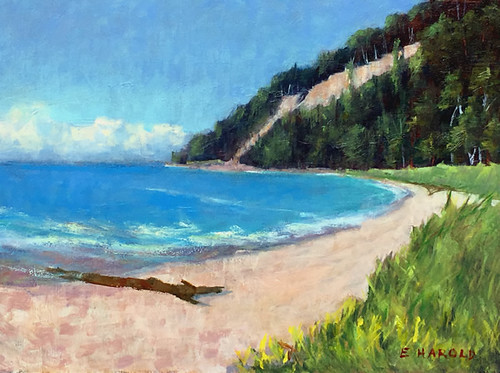 were so many miles between this beautiful place and home… it was a special kind of heartache. And now that we’re here, it’s a similar ache that comes with the changing of each season — each so beautiful and perfect in its own way, but never staying for very long.
“It is a simple melody, the harmonies are not complex,” Laura notes. “The waltz tempo is slow and easy — just how we all hope those perfect summer nights will pass: slow and easy.”
We look forward to presenting Laura’s latest creation at our upcoming concert as we celebrate the ending of one season and the beginning of another. We hope you can join us for one last waltz.
Remember, for more information about our collaborating artist, Ellie Harold, visit www.EllieHarold.com.